The Environmental Cost of Industrial Growth
In the valley where Meghalaya meets Assam, the largest employers and the worst air share the same coordinates. That is the whole dilemma.
Documented facts
Byrnihat has repeatedly appeared at or near the top of national particulate-matter rankings published by the Central Pollution Control Board (CPCB monitoring data).
Documented evidenceConsent to operate under the Air Act 1981 is issued by the state pollution control board and can be conditioned or refused (Act text).
Documented evidencePost-clearance monitoring is a recognised weak point in Indian environmental regulation (parliamentary and CAG reviews).
Documented evidenceThe National Green Tribunal can hear challenges to clearances by affected persons (NGT Act 2010).
Documented evidence
Timeline
- March 23, 1974Water Act creates state pollution control boards and the consent regime.Documented evidence
- May 16, 1981Air Act establishes air-quality standards and closure powers.Documented evidence
- May 23, 1986Environment (Protection) Act provides umbrella standard-setting and clearance powers.Documented evidence
Geographical context
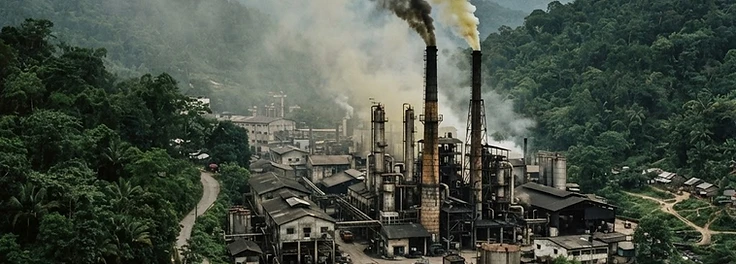
Byrnihat sits on the Assam–Meghalaya border in the Ri-Bhoi district, in a valley that concentrates industry along a single corridor: cement, ferro-alloys, coke and related units. The surrounding villages are close to the plant boundaries. The topography traps air in the valley, particularly in winter when a shallow inversion holds pollutants near the ground.
Scientific context
The cluster's emissions include particulate matter, sulphur dioxide and nitrogen oxides. Continuous monitoring has placed the area among the most polluted in national rankings for particulate matter, which is why it became nationally visible. Exposure is unequal within the valley: outdoor workers and residents of the nearest settlements breathe concentrations that indoor, air-conditioned spaces partly filter. Health effects follow the documented pathways for respiratory and cardiovascular illness.
Applicable environmental law
- · Water (Prevention and Control of Pollution) Act, 1974 — consent regime and state pollution control boards
- · Air (Prevention and Control of Pollution) Act, 1981 — standards, consent to operate, closure directions
- · Environment (Protection) Act, 1986 — umbrella powers, standards and environmental clearance
- · Environmental Impact Assessment Notification, 2006 — appraisal and post-clearance monitoring
- · National Green Tribunal Act, 2010 — review of clearances and remediation orders
Community response
Residents have raised concerns about dust, health and water through local organisations and, in some cases, through the tribunal. Their position is complicated by employment: the plants are among the area's largest sources of wages, and criticism can be read as opposition to jobs. Workers' organisations have focused on occupational exposure inside the plants, which is a separate legal question from ambient air quality.
Institutional response
The state pollution control board issues consents and inspects, the central board sets standards and publishes monitoring data, and the tribunal hears challenges. Enforcement runs through notices, timelines and, rarely, closure directions. The recurring gap is capacity: a small regulatory staff against a dense industrial cluster, with post-clearance monitoring historically the weakest link.
Current documented status
The cluster remains among India's most polluted in national particulate rankings, and monitoring has expanded. Compliance action has taken the form of notices and conditions rather than sustained operational restrictions.
From stack to bloodstream
Air pollution is not a cloud over a factory. It is a sequence in which each link can be measured, permitted and, in principle, interrupted.
Cement kilns, ferro-alloy furnaces and coke plants release particulate matter, sulphur dioxide and nitrogen oxides. Emission limits exist for each category of plant.
Exposure pathway described from published air-quality and health literature. It is a general mechanism, not a measurement at a specific household.
The economy and the exposure are the same geography
Residents of nearby villages
Bear the exposure while holding the least formal influence over consent conditions or operating hours.
Plant workers
Depend on the same industry for wages, which makes speaking about pollution a livelihood decision as well as a health one.
Industrial operators
Hold consents that permit emissions within limits, and are required to report and to operate monitoring equipment.
State pollution control board
Issues consents, inspects and can direct plant closure — with staffing that is small relative to the number of units.
Central Pollution Control Board
Sets national standards and publishes monitoring data, including comparative city rankings that made this cluster nationally visible.
Positions are analytical readings of the record. No individual worker or resident is quoted or characterised.
Four instruments, one enforcement question
Indian pollution law is not silent. The dispute is about implementation capacity and the consequences of non-compliance.
Water Act
Creates state pollution control boards and a consent regime for discharges into water.
Implementation gap: Consent conditions are only as strong as the inspection and prosecution capacity behind them.
Check your reading
Why does the same monitoring data produce different conclusions about whether this cluster is a problem?
Sources & further reading
- Central Pollution Control Board — air quality monitoring and city rankingsCentral Pollution Control Board, India, 2024 · official statistics
- The Air (Prevention and Control of Pollution) Act, 1981Government of India, 1981 (as amended) · legislation
- Environmental clearance and appraisal recordsMinistry of Environment, Forest and Climate Change, 2024 · regulatory record
- National Green Tribunal ordersNational Green Tribunal, India, 2024 · court decisions
Links open the publisher's own page. Figures are quoted with their year and scope; where evidence is contested or incomplete, the story says so rather than filling the gap.
Contributors may withdraw permission or request corrections at any time. Request a correction.