The Limits of Environmental Compensation
On an island where species live nowhere else, compensation has nowhere to go. The Great Nicobar project tests what environmental clearance can actually promise.
Documented facts
Great Nicobar is approximately 1,045 km², the majority of it forested (Andaman and Nicobar Administration records).
Documented evidenceThe island supports endemic species and leatherback turtle nesting beaches of national significance (Wildlife Institute of India surveys).
Documented evidenceIn 2024 the National Green Tribunal set aside the project's clearances and ordered fresh appraisal (NGT order).
Documented evidenceTribal reserve protections for Shompen and Nicobarese communities derive from the 1956 Regulation (regulation text).
Documented evidence
Timeline
- January 1, 1956Protection of Aboriginal Tribes Regulation establishes the tribal reserve framework.Documented evidence
- September 14, 2006EIA Notification sets appraisal and consultation requirements for specified projects.Documented evidence
- January 6, 2011Island Protection Zone Notification adds restrictions on island coastal activity.Documented evidence
- January 1, 2024National Green Tribunal sets aside the clearances and directs fresh appraisal.Documented evidence
Geographical context
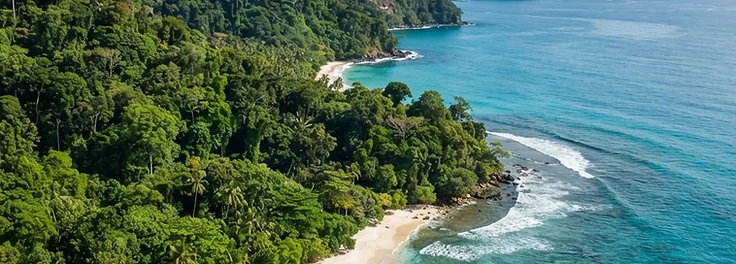
Great Nicobar is the southernmost large island of the Andaman and Nicobar chain, roughly 1,045 square kilometres, most of it forest. It holds the Galathea Bay area, nesting beaches for leatherback turtles, and habitat for endemic species. The island is also home to Nicobarese and Shompen communities, with statutory protections for tribal areas and a tribal reserve. A proposed port, airport, township and power plant would be built in this setting.
Scientific context
Island biogeography is unforgiving: small, isolated habitats support fewer species, and endemics — species found only there — cannot be conserved elsewhere. A local extinction on Great Nicobar is a global one. Construction on this scale affects the island through land clearing, dredging and sedimentation, underwater noise, artificial light and in-migration. These effects interact; the assessment of each separately understates the combined pressure on a bounded island.
Applicable environmental law
- · Forest (Conservation) Act, 1980, as amended in 2023 — diversion approval and compensatory conditions
- · Environmental Impact Assessment Notification, 2006 — appraisal and public consultation
- · Coastal Regulation Zone Notification, 2019 — coastal construction and reclamation
- · Island Protection Zone Notification, 2011 — additional restrictions on island coastal areas
- · Andaman and Nicobar Islands (Protection of Aboriginal Tribes) Regulation, 1956 — tribal reserve protections
Community response
Nicobarese and Shompen interests have been raised through statutory bodies and in submissions to the appraisal process, and residents' groups have challenged the clearances before the tribunal. The core concern expressed in those submissions is not only the footprint but the demographic and land-use change that follows a project of this scale on a small island.
Institutional response
The expert appraisal committee assesses the project and sets conditions, the island administration controls land and permits, and the tribunal reviews legality. Each has a defined role; none is mandated to weigh the cumulative effect on an island as a whole. The institutional question raised by the case is whether procedural compliance is sufficient when the receiving ecosystem is small, finite and partly irreplaceable.
Current documented status
The National Green Tribunal set aside the environmental and coastal clearances in 2024 and directed fresh appraisal, holding that the record had not been properly examined. The project's status depends on that renewed process and any appeal; verify the current position before relying on it.
What an island project touches
On a small island, the components of an impact assessment are not separate chapters. They share the same coastline.
Port, airport, township and power infrastructure require land, much of it under forest. Diversion triggers central approval and compensatory conditions.
Project components and safeguards described from public project documents and regulatory notifications. No impact is attributed to a specific construction phase beyond what those documents record.
Official assessment and independent evidence
The two columns below are not 'claims' and 'truth'. They are two bodies of evidence produced by different processes, with different incentives and different limits.
As presented in project documentation
- · Infrastructure is framed as strategically important for transshipment and national capacity.
- · Impacts are assessed within the boundaries of the project area and mitigated through conditions.
- · Compensatory measures — plantation, rescue and rehabilitation — are offered as offsets.
As documented by independent reviewers
- · Island ecosystems have limited area to absorb cumulative effects, and species ranges are confined to the island.
- · Some impacts — on endemic species and on communities — cannot be offset elsewhere, because there is no elsewhere.
- · Baseline data are thin, so the absence of a recorded impact may reflect survey gaps rather than absence of harm.
Characterisations summarised by EJA editors from the public record, including submissions to the appraisal process and tribunal filings. This is not a finding of fact by any court.
Which safeguards apply, and where they were tested
The island is protected by several overlapping regimes. The case turned on how those regimes were applied together.
Environmental Impact Assessment Notification
Sets out which projects need clearance, what an assessment must contain, and how the public is to be consulted.
Implementation gap: Appraisal quality depends on the expert committee's scrutiny and on the adequacy of the developer's baseline studies.
Legal positions summarised for readability and may have changed since the last review. For the operative position, read the tribunal's order and subsequent appellate decisions.
Who is in the room
Shompen and Nicobarese communities
Live with the consequences of land use and demographic change, with consent protections that are legally significant and practically contested.
Island ecosystems and endemic species
Cannot relocate. Endemism means a local loss is a global one.
Project developer and public authorities
Hold the approvals and the strategic rationale, and control the pace of construction.
Expert appraisal committee
Determines whether conditions are adequate and whether the appraisal record is sufficient.
Courts and tribunals
Review procedure and legality, but do not substitute their own assessment of the project's merits.
Sources & further reading
- Island Protection Zone notification and coastal regulationMinistry of Environment, Forest and Climate Change, 2011, 2019 · regulation
- Environmental Impact Assessment Notification, 2006Ministry of Environment, Forest and Climate Change, 2006 (as amended) · regulation
- National Green Tribunal orders and judgmentsNational Green Tribunal, India, 2024 · court decisions
- Nicobar Islands biodiversity and tribal reserve recordsAndaman and Nicobar Administration, 2024 · institutional record
Links open the publisher's own page. Figures are quoted with their year and scope; where evidence is contested or incomplete, the story says so rather than filling the gap.
Contributors may withdraw permission or request corrections at any time. Request a correction.