The Unequal Burden of Extreme Heat
In Jacobabad, the heat is not a weather event. It is a daily test of who can afford water, shade and rest — and who cannot.
This feature combines EJA's analysis with cited public sources. Contributor observations are labelled as such, figures are given with their year and scope, and sources are listed at the end.
By late May, the plain around Jacobabad stops cooling down at night. The air holds the day's heat until morning and hands it back. Children sleep on the roof because the rooms are hotter than the sky. The water tankers come late, or they do not come.
This is what a heat wave looks like when it lasts for months. Not a single day of record temperature, but a season in which the body never gets the break it needs. Sweat stops working when the air is too hot and too wet at the same time. Then the body's own cooling system fails, and a healthy adult can die within hours.
Jacobabad has crossed that threshold on some days. Its mix of heat and humidity has, at times, reached the level scientists consider the limit of human survival. The city now organises its year around a single question: who has a way to get out of the sun, and who does not.
The answer follows money and land. It also follows decisions made far from the city — in irrigation departments, provincial assemblies, courts and power ministries. That is where this story goes.
The environmental problem
Heat in South Asia is measured in two ways, and the difference matters.
A thermometer reading tells you how hot the air is. A second measure, called wet-bulb temperature, also accounts for humidity, which is what stops sweat from evaporating. A dry 50C day can be survivable. A humid 35C day may not be, because the body has no way to shed heat.
Jacobabad has had days that approach that limit. The city is not on the coast, but it sits in an irrigated basin where canals and rice fields add moisture to already brutal air. As the climate warms, those two problems — the heat itself and the humidity — are arriving together.
Electricity is the first line of defence, and it fails. Load-shedding schedules can cut power for hours at a time in the hottest part of the day. For households with air conditioning, that turns a hot afternoon into an emergency. For households without it, power makes no difference at all.
Water is the second. Canal water is allocated by a system built for irrigation, not for cities, and the tail-end villages get what is left. Drinking water is often purchased, delivered by tanker, and stored in whatever containers a family owns.
Trees and shade are the third, and they are disappearing as land is divided and sold.
The scientific picture is well established: heat waves in this region are becoming more frequent, longer and more severe. The local picture — which neighbourhoods lose power, which villages lose water — is documented mostly by the people living through it.
The human dimension
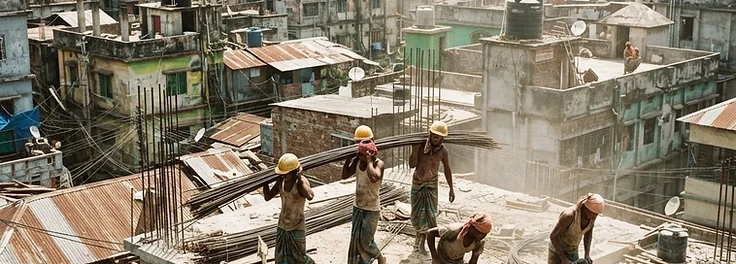
A labourer who works in the sun cannot choose to start at dawn if his employer does not. A nurse on a twelve-hour shift in a hospital with a failing generator cannot drink enough water to keep going. A farmer whose rice crop needs standing water in June cannot decide to use less.
Heat illnesses — heat exhaustion, heat stroke, kidney injury from repeated dehydration — are common and poorly recorded. Deaths are often attributed to "natural causes" on a certificate. The numbers in official statistics are almost certainly too low, and everyone working in the district knows it.
Women take on a larger share of the burden without being counted. They cook over gas or wood in unventilated kitchens, manage the household water supply, and care for elderly relatives and small children, who are the most vulnerable to heat. When a tanker comes, someone has to be at home to meet it, in the hottest part of the day.
Cooling is not shared equally. Some homes have air conditioning, a generator and a water tank on the roof. Others have a fan connected to a supply that may or may not be on.
The contributor's own observations in this entry are presented as testimony, not measurement. Where national or international data exist, they are cited separately. This distinction is the reason the story is published as a personal account rather than a research report.
The legal and policy framework
Pakistan's Constitution and its right to life
- Legal foundation
- The Supreme Court has read the constitutional right to life to include the right to a clean environment and to live in dignity. That interpretation is the foundation for most environmental litigation in Pakistan.
- Substantive obligations
- The state must protect life, which courts have said includes protecting people from environmental harm.
- Institutional responsibilities
- The Supreme Court and provincial high courts, acting on petitions brought by citizens and public interest groups.
- Enforcement mechanisms
- Court orders directing governments to act, monitored through follow-up hearings.
- Implementation gap
- A court order can require a heat plan. It cannot deliver one. Compliance depends on the same departments that were failing before, and judicial monitoring is slow.
- Environmental justice implications
- The right to life is universal on paper. The help it produces arrives through litigation, which requires a lawyer, a filing fee and years of patience — resources the people most exposed do not have.
Provincial disaster management legislation
- Legal foundation
- Provincial disaster management authorities are responsible for preparing for and responding to hazards, including heat waves.
- Substantive obligations
- Authorities are expected to maintain plans, issue warnings, coordinate response, and operate relief mechanisms.
- Institutional responsibilities
- Provincial disaster management authorities, district administrations, health departments and the Pakistan Meteorological Department.
- Enforcement mechanisms
- Annual reporting, budget allocation and provincial cabinet oversight.
- Implementation gap
- Heat has only recently been treated as a disaster, and plans are new. Warning systems exist but reach people through phones and media, which the poorest may not have. Emergency response is generally better at floods than at heat, because floods are visible.
- Environmental justice implications
- A warning nobody receives is not a warning. The people most at risk are the least likely to be reached by an alert, a relief camp or a cooling centre.
Environmental protection legislation and national climate policy
- Legal foundation
- Pakistan's environmental law and its national climate policy commit the state to adaptation, including measures for vulnerable communities.
- Substantive obligations
- Policy commitments to adaptation planning, early warning and climate finance, implemented through provincial programmes.
- Institutional responsibilities
- Ministry of Climate Change, provincial environment departments, and the National Disaster Risk Management Fund.
- Enforcement mechanisms
- Budgetary and administrative. Policy targets are not legally enforceable by an individual citizen.
- Implementation gap
- The gap between policy and delivery is money and authority. Adaptation is funded largely by international climate finance, which is slow, earmarked and unpredictable.
- Environmental justice implications
- Countries that contributed least to global emissions receive the least adaptation finance. Within Pakistan, the same pattern repeats between districts.
Labour protection legislation
- Legal foundation
- Provincial labour laws set working conditions, hours and safety obligations for employers.
- Substantive obligations
- Employers must provide safe working conditions. Some provinces have restricted outdoor work during extreme heat.
- Institutional responsibilities
- Provincial labour departments and inspectors.
- Enforcement mechanisms
- Inspection and penalties. In practice, most heat-exposed work takes place in the informal economy, where no inspection reaches.
- Implementation gap
- A law that covers formal employees offers little protection to the workers who are most exposed, most of whom are hired by the day and paid by the task.
- Environmental justice implications
- Heat protections that apply only to documented workers grant safety as a benefit of employment status rather than as a right of personhood.
Water allocation law and canal regulation
- Legal foundation
- Water in the Indus basin is allocated through historic agreements and provincial canal systems, administered by irrigation departments.
- Substantive obligations
- Departments distribute canal water according to established shares, and holders of water rights may use their allocation.
- Institutional responsibilities
- Provincial irrigation departments, canal officers and the Indus River System Authority.
- Enforcement mechanisms
- Canal officers enforce distribution, with limited capacity to detect theft or to protect the tail reaches.
- Implementation gap
- The allocation system is designed around agriculture and does not provide drinking water to cities as a priority. Household supply is the responsibility of municipal bodies, which have their own water, and their own problems.
- Environmental justice implications
- When the water that reaches a village depends on where it sits along the canal, so does the household's ability to survive the summer.
- Climate Change Act 2017
- National Climate Change Policy 2021
- National Adaptation Plan 2023
- National Disaster Management Act 2010 and provincial disaster management law
- Provincial factories acts and occupational safety and health legislation
- National Clean Air Policy 2023; provincial environmental protection acts
The psychology of environmental injustice
People do not respond to heat as a statistic. They respond to how it feels and to what they can do about it.
The first thing to go is attention. Heat makes thinking harder and tempers shorter, and that is physical, not a matter of willpower. In a place like this, decisions get postponed, and the cost of postponing them is paid later in health.
The second is what researchers call a sense of control. Public advice — stay indoors, drink water, avoid the sun — assumes choices that many people do not have. Told to rest in the afternoon, a daily-wage labourer hears advice he cannot follow, and may hear it as blame.
The third is trust. Warning systems and relief services are only as good as people's belief that they will be delivered. Where past warnings came with no help and past relief lists went to the well connected, households build their own preparations and discount official ones.
The fourth is community memory. Heat is not remembered the way floods are, because there is nothing to photograph the morning after. Deaths are dispersed, often attributed to other causes, and the risk fades from public attention before the next summer.
None of this is fatalism. It is what people do when a hazard is relentless, poorly reported and unequally shared.
Environmental justice analysis
Ask who dies in a heat wave, and the answer is the same everywhere: people who work outside, people who live in houses without shade or cooling, people without water, people who are old or very young or pregnant, and people with no way to leave.
In Jacobabad, those categories overlap with income, land ownership and the position of a village along a canal. The heat is the same. The protection is not.
There is a second imbalance, harder to see. The emissions that have warmed this region were produced mostly elsewhere. Pakistan accounts for a very small share of the greenhouse gases in the atmosphere. Its people are near the front of the queue for the consequences.
A third concerns procedure. Decisions about canal water, load-shedding and municipal services are taken by departments that citizens cannot easily reach, and the plans meant to protect them are written and reviewed in rooms they are not in.
Recognition matters too. Official heat deaths are undercounted, which shapes how much money and attention the problem receives. A hazard that does not appear in the statistics does not appear in the budget.
Institutions and accountability
Responsibility for heat in Jacobabad is spread across at least five institutions: the provincial disaster authority, the health department, the power utility, the irrigation department and the municipal body. Each controls a piece of the problem. None controls the whole.
That structure produces a predictable result. Load-shedding is decided by the power utility with no reference to heat mortality. Canal water is allocated by irrigation with no reference to household drinking supply. Heat warnings are issued by a meteorological office that does not decide what happens next. Plans exist, but they are plans for departments, not for the city.
There is real progress. Some provinces have restricted outdoor work in extreme heat. Warning systems now issue heat-specific alerts in advance. Heat has entered national adaptation planning and has been named as a health risk in international reporting.
What is missing is one body with a single heat mandate and a published record: who was warned, who received help, which neighbourhoods lost power, and how many died. Without that, heat remains a hazard that everyone is responsible for, which is another way of saying that no one is.
Heat is the least dramatic climate hazard and among the deadliest, because it works quietly, indoors and at night, and leaves almost no evidence behind. What protects people from it is not a policy document. It is water that arrives, power that stays on, a room that is cool and the freedom to stop working when the day becomes dangerous. Those are things a city decides to provide.
Evidence base
Compiled from the public record. Contributor observations are not included here.
Jacobabad has recorded combinations of heat and humidity that test the scientific limit of human survivability (peer-reviewed climate research; reported figures, 2021–2023).
Documented evidenceHeat waves in South Asia have become more frequent and longer lasting since 1950, and are projected to intensify further (IPCC, Sixth Assessment Report).
Documented evidencePakistan contributes a very small share of global greenhouse gas emissions while ranking among the countries most exposed to climate risk (international climate indices).
Documented evidenceThe Supreme Court has interpreted the constitutional right to life to include the right to a clean environment (Supreme Court of Pakistan jurisprudence).
Documented evidenceProvincial authorities issue heat wave advisories in advance of extreme heat episodes during the summer season (Pakistan Meteorological Department and provincial disaster authority advisories).
Documented evidence
- June 22, 2015A heat wave in Karachi kills more than 1,200 people, forcing heat onto the national agenda.
- January 1, 2021Climate research identifies near-limit heat and humidity conditions in Jacobabad and nearby districts.
- May 1, 2022Record spring heat across northern India and Pakistan damages wheat harvests and strains power supply.
Global mean surface temperature anomaly, 2015–2024
A single year of heat is weather. A decade of record years is the context in which Pakistan's heatwaves are now experienced.
Six of the ten warmest years on this record fall in the last decade — the baseline against which local heat plans are being written.
Scope: Global annual mean, relative to the 1951–1980 baseline (NASA GISTEMP v4, values rounded to 0.01 °C)
View the data table
| year | Global mean surface temperature anomaly, 2015–2024 |
|---|---|
| 2015 | 0.9 °C |
| 2016 | 1.01 °C |
| 2017 | 0.92 °C |
| 2018 | 0.85 °C |
| 2019 | 0.98 °C |
| 2020 | 1.02 °C |
| 2021 | 0.85 °C |
| 2022 | 0.89 °C |
| 2023 | 1.17 °C |
| 2024 | 1.28 °C |
Source: NASA GISS, GISTEMP v4. The series is global, not national; Pakistan's own warming is consistent with regional trends but is measured separately by the Pakistan Meteorological Department.
Four instruments, one unfinished chain
Pakistan has the legal architecture for adaptation. The gap is between instruments and the people who need them on the hottest day.
National Climate Change Policy
Sets adaptation as a national objective and asks provinces to prepare sectoral plans, including for extreme heat and water scarcity.
Implementation gap: A policy is not enforceable on its own; provincial implementation has depended on donor-funded projects rather than standing budgets.
Instruments are described from their official text. Assessments of implementation are EJA analysis, not findings of any court or regulator.
Who absorbs the heat
Heat is not distributed by temperature alone. It moves along the lines of occupation, housing and access to powered cooling.
Outdoor and construction workers
Work continues through peak hours in much of the informal economy, where piece-rate pay makes stopping an unpaid decision.
Households without reliable power or water
Load-shedding and pump dependence convert a heatwave into a water emergency as well as a temperature one.
Provincial disaster authorities
Hold the mandate for alerts and relief, but act through district capacity that varies sharply.
Electricity utilities and distributors
Control the supply whose reliability determines whether cooling is available at the moment it is needed.
Residents of informal settlements
Often outside formal planning and cooling-centre catchment, with the least voice in how adaptation money is allocated.
Positions describe the structure of the problem as EJA reads it. They are not statements by, or about, named individuals.
Check your reading
Pakistan's contribution to global greenhouse-gas emissions is small, yet its heat exposure is severe. Which figure is closest to its share of global emissions?
Sources & further reading
- GISS Surface Temperature Analysis (GISTEMP v4)NASA Goddard Institute for Space Studies, 2025 · official dataset
- Climate change, heat and healthWorld Health Organization, 2023 · official statistics
- Pakistan Climate Change Act, 2017Ministry of Climate Change and Environmental Coordination, Pakistan, 2017 · legislation
- AR6 Synthesis Report: Climate Change 2023IPCC, 2023 · peer-reviewed assessment
Links open the publisher's own page. Figures are quoted with their year and scope; where evidence is contested or incomplete, the story says so rather than filling the gap.
Similar stories around the world




Contributors may withdraw permission or request corrections at any time. Request a correction.