When the Rain Exceeds the City's Limits
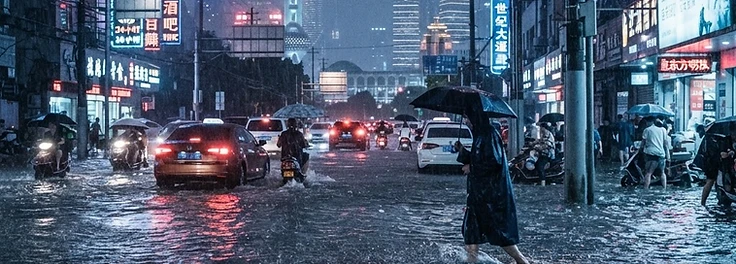
Shanghai's answer to heavier rain is to make the city absorb water. The engineering is measurable; the protection it promises is not absolute.
Documented facts
National sponge-city guidance targets control of about 70 per cent of rainfall in built-up areas by 2030, with pilot areas around 80 per cent (MOHURD guidance).
Documented evidenceA return period describes the average interval between events of at least a given magnitude; a 1-in-5 year storm has roughly a 20 per cent chance in any year (hydrological definition).
Documented evidenceShanghai's low elevation and tidal rivers make drainage dependent on pumping as well as pipe capacity (municipal flood-control documentation).
Documented evidenceGreen infrastructure performance declines without maintenance as ponds silt and permeable surfaces clog (published urban drainage research).
Documented evidence
Timeline
- December 12, 2013Sponge city concept adopted in national urbanisation policy.Documented evidence
- April 1, 2015First pilot cities selected with performance targets for rainfall retention.Documented evidence
- January 1, 2016Shanghai introduces municipal sponge-city implementation measures.Documented evidence
- January 1, 2030National target date for 70 per cent rainfall control in built-up areas.Documented evidence
Geographical context
Shanghai is low-lying, densely built and crossed by the Huangpu River and Suzhou Creek, with outfalls that depend on river and tide levels. Districts differ sharply in age, drainage standard and green space. Sponge-city projects are distributed across the city: green roofs, permeable pavement, retention ponds and wetland parks, each holding back water from a network sized for a particular storm.
Scientific context
Urban drainage is designed to a return period — a probability statement, not a guarantee. A 1-in-5 year standard means roughly a one-in-five chance of being exceeded in any given year, which over a city's lifetime means repeated exceedance. National sponge-city guidance set a target of capturing and controlling around 70 per cent of rainfall in built-up areas by 2030, with pilot areas expected to reach about 80 per cent. Green infrastructure reduces peak runoff, but its capacity depends on maintenance: silted ponds and clogged permeable surfaces lose function quietly.
Applicable environmental law
- · Water Law of the People's Republic of China — water resource allocation and flood control
- · Urban Drainage and Sewage Treatment Regulations — design standards and operating duties
- · Sponge city construction guidance (2014–2015) — national performance targets
- · Shanghai municipal sponge city measures — local implementation and assessment
- · Flood control and typhoon response plans — municipal emergency framework
Community response
District governments implement projects, and residents experience them as changes to streets and parks rather than as flood policy. Public consultation occurs mainly at project level, through neighbourhood committees. Where flooding recurs, residents' accounts of which underpasses and streets flood first are locally precise and rarely aggregated into city planning data.
Institutional response
The national housing and urban-rural development ministry sets the framework, the municipal water authority manages drainage and flood control, and districts deliver projects. The coordination challenge is that green infrastructure, pipes and pumping must be upgraded together; upgrading one without the others moves the failure point rather than removing it.
Current documented status
Sponge-city construction continues across districts alongside drainage upgrading and pumping-station renewal. Residual risk remains by design, and the maintenance of completed green infrastructure is the emerging concern.
What 'drainage capacity' actually promises
A return period is a statement about probability, not a promise of protection. Reading the number correctly changes what counts as failure.
- Typical older urban drainage standard1-in-1 year
A standard designed to handle the rainfall expected once a year on average. Anything more intense exceeds the design.
- Upgraded standard for dense central districts1-in-3 to 1-in-5 years
Reported upgrade path for major districts. Still exceeded regularly over a city's lifetime.
Upgrading from a 1-in-1 to a 1-in-5 standard reduces flooding frequency. It does not eliminate flooding — and a 1-in-50 event still arrives eventually.
Source: national sponge-city guidance and municipal drainage upgrading reports. Reported standards vary by district and have changed over time; treat them as indicative.
Where sponge-city design intervenes
The programme changes the route water takes through the city, not the amount of rain that falls.
Intense convective storms and typhoon remnants deliver large volumes in short periods. Climate change is increasing the intensity of extreme rainfall.
Programme elements described from national guidance and municipal reporting. Flow is a schematic; it is not a hydraulic model of any district.
A national programme delivered locally
Sponge-city policy is set centrally, funded through pilot selection, and built by municipalities that own the drainage.
Sponge city concept adopted
Reframes urban water management around retention, infiltration and storage rather than drainage alone.
Implementation gap: The concept asks for performance across a whole city, while investment is delivered project by project.
Two terms decide how the numbers above should be read.
Sources & further reading
- Sponge city construction guidanceMinistry of Housing and Urban-Rural Development, China, 2014–2015 · government policy
- Shanghai municipal government — sponge city programmeShanghai Municipal People's Government, 2024 · institutional record
- Urban adaptation and flood riskEuropean Environment Agency (comparative context), 2024 · official analysis
Links open the publisher's own page. Figures are quoted with their year and scope; where evidence is contested or incomplete, the story says so rather than filling the gap.
Similar stories around the world




Contributors may withdraw permission or request corrections at any time. Request a correction.