The Price of an Irreplaceable Forest
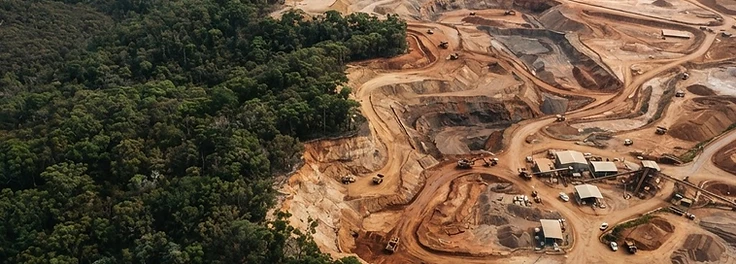
Bauxite mining clears a forest that took millennia to assemble. Rehabilitation replants it, but the climate that shaped it is drying.
Documented facts
South-west Western Australia's rainfall declined markedly after the mid-1970s; the post-2000 average is roughly 730 mm against about 860 mm before 1975 (Bureau of Meteorology analyses, rounded).
Documented evidenceThe jarrah forest supports species found nowhere else, including threatened black cockatoos (DBCA species records).
Documented evidenceDieback caused by Phytophthora cinnamomi is a documented threat across south-west forests (DBCA).
Documented evidenceBauxite rehabilitation requirements are enforced through conditions attached to state and federal approvals (EPA WA).
Documented evidence
Timeline
- July 16, 1999Environment Protection and Biodiversity Conservation Act commences.Documented evidence
- January 1, 2024Forest Management Plan 2024–2033 takes effect for south-west public forests.Documented evidence
- June 1, 2024Periodic environmental review of approved mining projects reports on rehabilitation performance.Documented evidence
Geographical context
The Northern Jarrah Forest runs along the Darling Range east of Perth. Jarrah and marri dominate a forest that also supplies much of the city's catchment water and supports species found nowhere else. Mining occurs in patches across a large estate, moving through the forest over years. Because the patches are dispersed, the cumulative effect is a landscape of clearings and rehabilitation rather than a single scar.
Scientific context
Rehabilitation reconstructs a forest, not necessarily the same forest. Soil structure, seed banks and the fungal and invertebrate communities that drive regeneration are disturbed by clearing and cannot simply be replaced by planting. South-west Western Australia's rainfall has also stepped down since the mid-1970s, with the post-2000 average roughly 130 mm lower than the pre-1975 average. In a drying climate, the completion criteria written for rehabilitation become harder to meet, and streamflow into Perth's dams declines further.
Applicable environmental law
- · Environment Protection and Biodiversity Conservation Act, 1999 — federal assessment of matters of national environmental significance
- · Environmental Protection Act, 1986 (WA) — state assessment and approval with conditions
- · Forest Management Plan 2024–2033 (WA) — conservation and use of south-west public forests
- · Mining rehabilitation conditions — completion criteria attached to project approvals
Community response
Residents of the hills towns and Perth water users have pressed for stronger rehabilitation standards and for scrutiny of cumulative clearing. Environmental groups have focused on dieback and on connectivity for threatened cockatoos. Traditional Owners assert cultural obligations to country that predate the mining tenure and argue that consultation does not amount to shared authority over outcomes.
Institutional response
The state environmental authority assesses proposals and sets conditions; the federal government assesses matters of national significance; the biodiversity department manages public forest and monitoring. The institutional gap is cumulative impact: approvals are assessed project by project, while the forest dries and fragments as a whole.
Current documented status
Mining and progressive rehabilitation continue under existing approvals. Completion criteria and the adequacy of offsets remain contested, and the drying trend continues to outpace assumptions built into older rehabilitation targets.
South-west Western Australia's rainfall, before and after 1975
The forest's ability to recover was assessed in a wetter climate. That climate has changed.
- 1910–1974 average≈860 mm
Long-term average for the south-west region before the step change in the mid-1970s.
- Post-2000 average≈730 mm
The decline is largest in the winter rainfall that refills soil and groundwater.
Rehabilitation targets written in the 1980s assume rainfall that no longer arrives, which is why forest recovery is now slower than the approvals assumed.
Source: Bureau of Meteorology station and regional analyses, rounded to the nearest 10 mm. Regional averages vary with the station set; the direction and scale of the decline are well established.
What clearing actually changes
Bauxite mining removes forest from a pit — but the effect that matters is the one that continues after backfilling.
The pit is cleared before mining. The forest is not only trees: it is soil structure, seed banks and a fungal and invertebrate community that took a long time to assemble.
Pathway based on published rehabilitation research and regulator reporting. It is a simplified account of a heavily scrutinised, site-specific process.
Four kinds of interest in one forest
Jarrah and marri forest ecosystems
Habitat loss, dieback caused by Phytophthora cinnamomi, and reduced streamflow compound one another.
Traditional Owners
Cultural landscapes and obligations predate the mining tenure; consultation is not the same as shared authority over outcomes.
Mining operators
Hold approved tenements, pay rehabilitation obligations and report against completion criteria they helped negotiate.
State environmental regulator
Assesses proposals, sets conditions and enforces them, with finite monitoring capacity across a large forest estate.
Residents and forest users
Lose access, amenity and catchment water in a region already adapting to a drying climate.
The approvals stack
A bauxite proposal must clear both state and federal law, then perform against conditions over decades.
Environment Protection and Biodiversity Conservation Act
Requires federal assessment of actions affecting matters of national environmental significance, including listed species and communities.
Implementation gap: Approvals are granted for defined areas and timeframes; cumulative landscape effects are handled through conditions rather than refused.
Approval dates and instruments are simplified. Federal and state processes run in parallel and have been amended repeatedly; consult the public registers for the current position.
Sources & further reading
- Bureau of Meteorology climate data and rainfall trendsAustralian Bureau of Meteorology, 2024 · official statistics
- Environmental Protection Authority approvals and assessmentsEnvironmental Protection Authority, Western Australia, 2024 · regulatory record
- Forest Management Plan 2024–2033Department of Biodiversity, Conservation and Attractions, 2024 · government policy
- Environment Protection and Biodiversity Conservation Act 1999Australian Government, 1999 (as amended) · legislation
Links open the publisher's own page. Figures are quoted with their year and scope; where evidence is contested or incomplete, the story says so rather than filling the gap.
Similar stories around the world

Contributors may withdraw permission or request corrections at any time. Request a correction.