The Price of a Plastic Bag
A five-cent charge on a bag is a tiny price signal. Whether it changes behaviour depends less on the money than on the moment of forgetting.
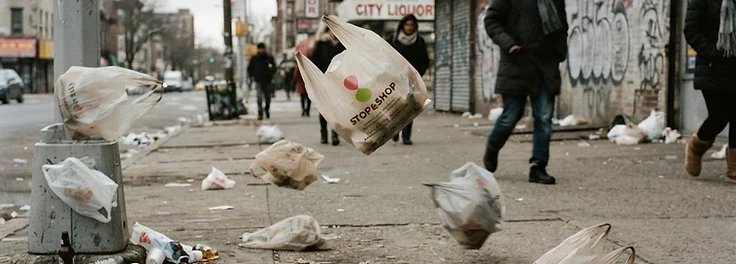
Documented facts
Washington, DC introduced a 5-cent charge on disposable carryout bags in 2010 under the Anacostia River Clean Up and Protection Act of 2009 (DC statute).
Documented evidenceMontgomery County and Prince George's County introduced comparable 5-cent fees in 2012 (county legislation).
Documented evidenceRevenue from the DC charge is directed to river cleanup and reusable-bag programmes (DOEE programme documentation).
Documented evidencePlastic bags are a documented and recurrent component of river trash in the Anacostia watershed (cleanup monitoring reports).
Documented evidence
Timeline
- July 1, 2009Anacostia River Clean Up and Protection Act enacted in the District of Columbia.Documented evidence
- January 1, 2010DC bag charge takes effect.Documented evidence
- January 1, 2012Montgomery and Prince George's counties introduce comparable fees.Documented evidence
Geographical context
The policy was built around a river. The Anacostia flows through Washington, DC and its Maryland suburbs, and decades of volunteer cleanups documented plastic bags as a dominant visible pollutant. Three adjacent jurisdictions — the District, Montgomery County and Prince George's County — adopted comparable fees within three years of one another, creating a regional norm across a shared watershed.
Scientific context
Single-use bags are light, durable and easily mobilised by wind and water, which is why they accumulate in waterways rather than in landfill. Their environmental significance is less about carbon than about persistence and the practical cost of retrieval. Fees and bans reduce distribution, but measured effects vary with exemptions, enforcement and how each jurisdiction counts. Reported reductions in the first years after adoption have generally been large, though not directly comparable between counties because the studies and baselines differ.
Applicable environmental law
- · Anacostia River Clean Up and Protection Act, 2009 (DC) — 5-cent charge from 2010, revenue to river cleanup
- · Montgomery County bag fee legislation, effective 2012 — with defined exemptions
- · Prince George's County bag fee legislation, effective 2012 — with defined exemptions
- · Chesapeake Bay clean-up framework — trash total maximum daily load obligations
Community response
River cleanup volunteers produced the evidence that made the policy possible: repeated counts of what was actually in the water. Retailers adapted with signage and bag alternatives, and some small businesses reported administrative burden. Reusable-bag distribution programmes accompanied the fees, recognising that a charge without an alternative is simply a cost.
Institutional response
Environmental agencies in each jurisdiction administer the charge and report on revenue, while elected councils set the level and exemptions. Enforcement is minimal because the fee is collected at the point of sale. The policy's transparency is one reason it has persisted: revenue goes to visible river work, which sustains public support.
Current documented status
Fees remain in force across the three jurisdictions, with different exemption lists. Debate has shifted to whether fees should be replaced by bans, and to preemption attempts in some US states that would prevent local bag laws altogether.
Three counties, one policy idea
The same instrument, adopted at different times and with different exemptions. The comparison is of legal design, not of measured outcomes.
| Jurisdiction | In force | Instrument | Scope and exclusions |
|---|---|---|---|
| Washington, DC | 2010 | 5-cent fee on disposable bags | Grocery, convenience and liquor stores; proceeds part-fund river cleanup |
| Montgomery County, MD | 2012 | 5-cent fee on disposable bags | Retail establishments; excludes certain exemptions such as produce bags |
| Prince George's County, MD | 2012 | 5-cent fee on disposable bags | Retail establishments, with defined exemptions |
Source: municipal programme pages, checked against each jurisdiction's published guidance. Fee levels and exemptions have changed since adoption; verify locally before relying on them. Exemptions matter: a fee that exempts most bags changes nothing.
From river monitoring to price signal
The policy did not begin with a theory about behaviour. It began with what volunteers were pulling out of a river.
Trash monitoring in the Anacostia
Nothing yet — but repeated counts established plastic bags as a dominant, visible component of river trash.
Implementation gap: Visible litter is easier to legislate against than diffuse pollution, which is part of why the bag became the policy target.
The five-cent decision
A bag fee works at the moment of forgetting. That is a psychological mechanism, not only an economic one.
You are at a supermarket checkout without a reusable bag, and the store charges 5 cents per disposable bag. Which response is most consistent with what behavioural research would predict?
Illustrative scenario written by EJA editors from documented conditions. It is not survey data and reports no participant responses.
Who pays, who collects, who changes
Shoppers
Pay the fee per bag, or bear the inconvenience of bringing their own. The cost falls disproportionately on households without storage or transport.
Retailers
Remit the fee and display notices; small stores report administrative burden relative to revenue collected.
River and wildlife
The intended beneficiary — less plastic in the waste stream and fewer bags in the waterway.
Local government
Sets the level and exemptions and decides what happens to the revenue, which shapes public acceptance.
Positions are analytical. They describe the structure of the policy, not the views of any group surveyed.
Check your reading
A county wants to cut plastic bag use quickly, with limited enforcement capacity. Which design feature is most likely to matter?
Sources & further reading
- Skip the Bag programme and river cleanup dataDistrict Department of Energy & Environment, 2024 · official statistics
- Bring Your Own Bag programmeMontgomery County Department of Environmental Protection, 2024 · official policy
- Anacostia River cleanup and trash monitoringUS Environmental Protection Agency, 2024 · government report
Links open the publisher's own page. Figures are quoted with their year and scope; where evidence is contested or incomplete, the story says so rather than filling the gap.
Similar stories around the world




Contributors may withdraw permission or request corrections at any time. Request a correction.