The Invisible Labor of a Clean City
Cairo's streets are cleaned by a system the law does not fully recognise. Recognition, not technology, is the missing infrastructure.
Documented facts
Waste Management Law No. 202 of 2020 established a national waste regulatory authority and a licensing framework (official text).
Documented evidenceThe zabbaleen community in Manshiyat Naser performs a large share of Cairo's sorting and recycling (published research; UNEP reporting).
Documented evidenceUncontrolled disposal generates leachate and methane, with documented effects on water and air quality (World Bank sector reporting).
Documented evidenceGovernorates award waste collection contracts and set service standards (Egyptian administrative practice).
Documented evidence
Timeline
- January 1, 1967Municipal rules assign street cleaning and collection duties to local authorities.Documented evidence
- December 1, 2020Waste Management Law No. 202 of 2020 establishes the national regulatory framework.Documented evidence
- January 1, 2021Governorates begin restructuring collection under the new licensing framework.Documented evidence
Geographical context
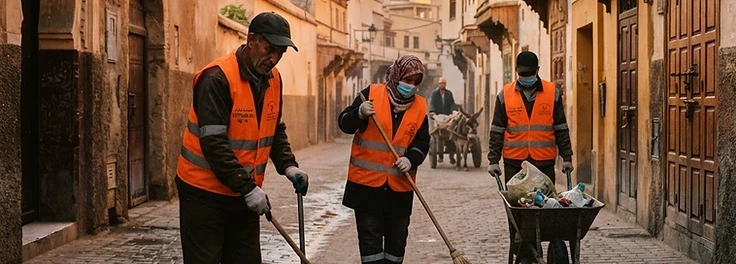
Cairo's waste is collected through overlapping systems: municipal contractors, private micro-enterprises and informal collectors who move material street by street. Manshiyat Naser, the settlement associated with the zabbaleen community, is the country's best-known sorting and recycling node. The Nile carries the consequences: leachate and plastic from uncontrolled sites reach the river that supplies the city.
Scientific context
Egypt generates tens of millions of tonnes of waste a year across municipal, agricultural, construction and hazardous streams, with official and independent estimates diverging. Recovery depends on hand sorting before disposal. When material is mixed and buried, it produces methane and leachate instead; when it is sorted, it substitutes for virgin material. The environmental difference between those outcomes is created by labour that is largely informal.
Applicable environmental law
- · Waste Management Law No. 202 of 2020 — licensing, national authority, fees and private participation
- · Egyptian Environmental Affairs Agency framework — environmental impact assessment and inspection
- · Governorate service contracts — collection standards and penalties
- · Nile protection provisions — restrictions on discharge to the river
Community response
The zabbaleen have built recycling expertise over generations, with recovery rates reported well above the formal system's. Their organisations have argued for secure tenure, protective equipment and contracts rather than displacement. Residents' experience varies by district: where collection is contracted and reliable, the complaint shifts from accumulation to cost.
Institutional response
The 2020 law created a national regulatory authority to license operators and moved the sector towards contracted services. Governorates award and supervise those contracts. The integration question is decisive: licensing requirements designed for companies can exclude the micro-enterprises that already perform the service, in which case formalisation raises costs while reducing recovery.
Current documented status
Municipal contracting is expanding and the regulatory authority is building its licensing system. Whether informal collectors are employed, displaced or left to compete alongside contractors varies by governorate, and the effect on recovery rates is not systematically monitored.
The path a plastic bottle takes in Cairo
The formal and informal systems run in parallel, and the informal one does most of the actual recovery.
Waste enters a bin, a container or the street. In many districts, collection is organised street by street rather than by a municipal fleet.
Pathway compiled from published research on Cairo's waste system and the 2020 waste law. Flows vary widely between districts and are not quantified here.
Who does the work, who holds the contract
Zabbaleen and informal collectors
Recover most of the material value, with limited protective equipment, insecure tenure and exposure to price shocks.
Residents
Legally required to handle waste responsibly and to pay for collection, with service quality varying sharply by neighbourhood.
Municipalities and governorates
Award collection contracts and control access to disposal sites, which shapes whether informal systems survive.
Waste Management Regulatory Authority
Created under the 2020 law to regulate the sector and licence operators, integrating a system that was largely informal.
Recyclers and traders
Depend on the sorting labour that the formal system does not provide.
Positions are analytical. The zabbaleen's contribution is documented in published research; no individual is quoted.
Formalising a system that already worked
Egypt's waste law is recent, and its central question is what happens to the informal network when the sector is regulated.
Early municipal waste provisions
Assign responsibility for street cleaning and waste collection to local authorities, without a national sector framework.
Implementation gap: Municipal capacity has never matched urban growth, which is the gap the informal system filled.
Check your reading
A city contracts a single company to collect waste. What is the most likely unintended consequence for material recovery?
Sources & further reading
- Egyptian Environmental Affairs AgencyGovernment of Egypt, 2024 · institutional record
- Waste Management Law No. 202 of 2020Government of Egypt, 2020 · legislation
- What a Waste 2.0World Bank, 2018 · government report
- The Cairo zabbaleen and informal recyclingUN Environment Programme, 2021 · ngo report
Links open the publisher's own page. Figures are quoted with their year and scope; where evidence is contested or incomplete, the story says so rather than filling the gap.
Similar stories around the world


Contributors may withdraw permission or request corrections at any time. Request a correction.