Where the Waste Goes
India's waste rules are unusually detailed. Most of the failure happens where one actor's duty ends and the next begins.
Documented facts
The Solid Waste Management Rules, 2016 require waste generators to segregate waste into wet, dry and hazardous streams (Rule text).
Documented evidenceReported national municipal solid waste generation is roughly 0.16–0.17 million tonnes per day (CPCB, 2020–21 estimate).
Documented evidenceExtended producer responsibility for plastic packaging is administered through a national online credit system (CPCB guidance).
Documented evidenceCollection coverage in urban India is significantly higher than the share of waste that is processed (CPCB and CAG reporting).
Documented evidence
Timeline
- April 8, 2016Solid Waste Management Rules replace the 2000 rules and assign segregation duties to generators.Documented evidence
- August 12, 2021Amended plastic waste rules tighten extended producer responsibility and phase out identified single-use items.Documented evidence
- October 1, 2021Swachh Bharat Mission (Urban) 2.0 launched with a focus on processing and legacy waste.Documented evidence
Geographical context
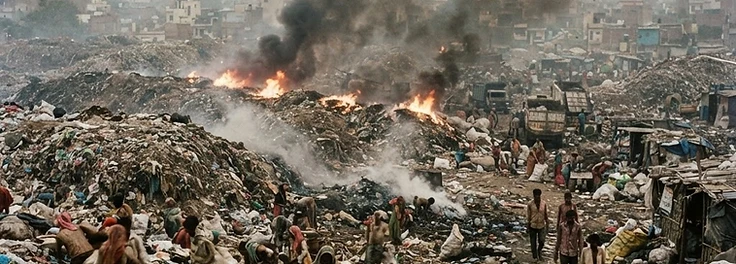
Urban India generates waste across dense, heterogeneous cities. Collection reaches most wards, but the material moves through a chain of vehicles, transfer points, informal sorting and processing sites before reaching a dump. Several metropolitan dumpsites have operated for decades and now stand taller than the neighbourhoods beside them, with leachate and periodic fires as permanent conditions rather than incidents.
Scientific context
Reported national generation is roughly 0.16–0.17 million tonnes per day, a figure that should be treated as an estimate because it aggregates municipal reporting of varying quality. Collection coverage in urban areas is comparatively high; processing is not. When segregated waste is mixed during collection, composting and recycling become costly and contaminated, so material that was recoverable ends up in landfill. Legacy dumps continue to emit methane and produce leachate long after they stop receiving waste.
Applicable environmental law
- · Solid Waste Management Rules, 2016 — duties of generators, municipalities and states
- · Plastic Waste Management Rules, 2016, amended 2021–2022 — extended producer responsibility
- · Construction and Demolition Waste Management Rules, 2016
- · Swachh Bharat Mission (Urban) 2.0 — programme funding and service standards
- · Environmental (Protection) Act, 1986 — underlying standard-setting power
Community response
Waste pickers' organisations have argued for recognition, identity cards and integration into municipal contracts, pointing out that recovery rates depend on labour the formal system does not employ. Resident groups near dumpsites have petitioned for closure and remediation, while residents elsewhere often resist new processing facilities in their own neighbourhoods.
Institutional response
Urban local bodies hold the operational mandate, state governments constitute monitoring committees and allocate land, and the central pollution board administers producer responsibility and publishes guidance. The structural problem is financial: user charges rarely cover full cost, so processing capacity is funded through schemes rather than recurrent revenue, and legacy remediation has no secure funding stream at all.
Current documented status
Segregated collection has expanded in many cities but remains inconsistent. Producer responsibility registration is now national and digital, while independent assessment suggests recovery rates lag the declared targets. Legacy dumpsite remediation is proceeding at a small number of sites with tribunal oversight.
The four stages where material is lost
Every stage below has a legally assigned owner. The failure is usually at the handover.
Households, shops and institutions produce mixed waste. Under the 2016 Rules, waste generators are required to segregate into wet, dry and hazardous streams at source.
Stage descriptions follow the duties set out in the Solid Waste Management Rules, 2016 and CPCB guidance. Reported national generation is roughly 0.16–0.17 million tonnes per day (CPCB, 2020–21), a figure that should be treated as an estimate.
Who is responsible for what
The 2016 Rules distribute duties across actors. Most public argument about waste failure is really an argument about which duty was not performed.
| Actor | Core duty under the Rules |
|---|---|
| Waste generator | Segregate waste at source; hand it only to the authorised collector; pay user fees where levied. |
| Municipality | Provide segregated collection, transport, processing and disposal; publish service information. |
| State government | Constitute a state-level monitoring committee, frame policy and ensure land for facilities. |
| Producer (plastics) | Meet extended producer responsibility targets for collection and recycling of their packaging. |
Summary of duties from the Solid Waste Management Rules, 2016 and the Plastic Waste Management Rules as amended. Consult the current consolidated text for exact wording and exemptions.
The people the system depends on
Informal waste pickers
Recover material at the point where the formal system loses it, without protective equipment, social security or recognition in municipal contracts.
Households
Hold a legal segregation duty that is rarely enforced and unequally served by collection.
Urban local bodies
Hold the operational mandate but depend on state land allocation and on revenue that rarely covers full cost.
Recyclers and processors
Depend on segregated input; their viability is undermined when collection delivers mixed waste.
Residents near dumpsites
Absorb leachate, fire and odour from sites they did not choose and cannot relocate away from.
Positions are analytical. The contribution of informal workers is documented in municipal and academic studies, not asserted here as a quotation.
Check your reading
Why does segregation at the household level matter more than any downstream technology?
Sources & further reading
- Solid Waste Management Rules, 2016Ministry of Environment, Forest and Climate Change, 2016 · legislation
- Plastic Waste Management Rules and EPR guidanceCentral Pollution Control Board, India, 2016, amended 2021–2022 · regulation
- Swachh Bharat Mission (Urban) 2.0Ministry of Housing and Urban Affairs, 2021–2026 · government programme
- What a Waste 2.0: a global snapshot of solid waste managementWorld Bank, 2018 · government report
Links open the publisher's own page. Figures are quoted with their year and scope; where evidence is contested or incomplete, the story says so rather than filling the gap.
Similar stories around the world


Contributors may withdraw permission or request corrections at any time. Request a correction.