The Hidden Environmental Cost of the Cloud
The internet runs on buildings. In northern Virginia, the people living beside them are discovering what that costs in electricity, water and quiet.
This feature combines EJA's analysis with cited public sources. Contributor observations are labelled as such, figures are given with their year and scope, and sources are listed at the end.
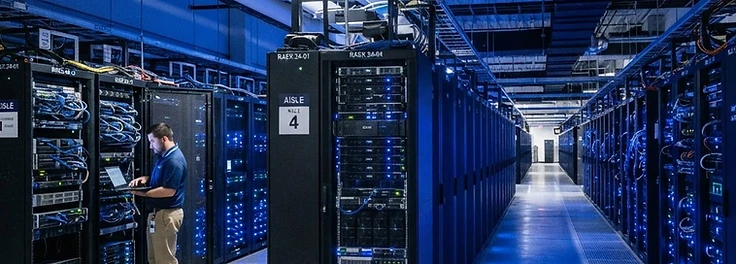
Drive west from Dulles airport and the warehouses start. Long, low buildings with no windows, humming behind chain-link fences. Some have generators the size of shipping containers lined up outside. Others have cooling towers with steam coming off them in winter.
These are data centres. Everything the internet does — storing a photo, streaming a film, asking a chatbot a question — happens in a building like this one, connected by cables to a few hundred similar buildings nearby.
Northern Virginia holds the largest concentration of them in the world. It became the industry's capital by accident of history: an early fibre connection, cheap land, and a state that wanted the business.
The industry brings tax revenue and construction jobs. It also brings something less discussed — an enormous and rapidly growing demand for electricity and water, placed on a grid and a set of towns that were built for something else. This story is about who supplies that demand, who pays for it, and who lives with the noise.
The environmental problem
A data centre is a machine for turning electricity into heat, and then getting rid of the heat.
Its power demand is measured in megawatts, the same unit used for power stations. A single large campus can draw as much as a small city. The industry's appetite in Virginia has grown fast enough that the state's main utility has repeatedly raised its forecast for future demand, and has delayed the retirement of fossil fuel plants to meet it.
Its water demand is less often reported. Many data centres use evaporative cooling, which is efficient in energy terms and consumes water — water that evaporates and does not return to the river or aquifer. In a dry summer, that competes directly with household supply.
There is also the land. Server halls are low-density buildings surrounded by parking and security fencing, and they generate almost no employment per acre. Counties that approve them gain tax revenue and lose developable land.
And there is noise. Cooling equipment and backup generators run continuously, and the low-frequency hum travels further than the sound of traffic. Residents in the towns next to these campuses have complained of sleep disturbance for years, and in some cases have taken their objections to county boards.
The carbon picture is complicated by the grid. A data centre's emissions depend on what supplies its power. As demand grows faster than renewable construction, utilities fill the gap with what they have.
The human dimension
The complaints from people who live near these buildings are consistent and specific.
It is the hum at two in the morning. It is the diesel generators tested monthly, which can be heard and smelled across a neighbourhood. It is the substation built at the end of a road, and the transmission lines widened to carry power that goes somewhere else.
It is also the money. Data centres pay property taxes, and in a county with a limited commercial base that revenue funds schools and services. Some residents who dislike the noise accept the trade. Others ask why they should bear the burden of a facility whose service they use but whose power lines cross their back garden.
Farmers describe a different cost. Transmission corridors take land and divide fields. Solar projects built to supply the grid compete with farming for the same acreage. And the water question, in a region that has spent decades arguing over a shared river, is unsettled.
The contributor's own experience of the noise and proximity of these facilities is testimony. The energy and water figures used here come from published forecasts and regulatory filings, and are cited separately.
The legal and policy framework
State air permitting under federal clean air law
- Legal foundation
- Data centres that run large backup generator installations need air permits covering their emissions, issued by the state environmental agency under federal requirements.
- Substantive obligations
- Operators must limit emissions, track run hours, and hold permits that specify testing and reporting. Backup generators are regulated on the assumption that they are used rarely.
- Institutional responsibilities
- The state environmental quality department, the federal environmental protection agency, and county authorities.
- Enforcement mechanisms
- Permit conditions, inspection and penalties. Enforcement is limited in practice by self-reporting.
- Implementation gap
- The permits were written for emergency equipment. When dozens of facilities cluster in one airshed, the combined emissions from testing and from grid-stress events are not assessed as a whole.
- Environmental justice implications
- Air quality effects fall on the people living downwind of the generators, who gain no direct benefit from the facility.
Local land use and zoning approval
- Legal foundation
- Counties control whether and where data centres may be built, through zoning rules and individual approvals.
- Substantive obligations
- Applicants must meet zoning conditions and, in some counties, submit noise, water and traffic studies.
- Institutional responsibilities
- County boards of supervisors, planning commissions and planning departments.
- Enforcement mechanisms
- Conditions attached to approvals, monitored through complaints and site inspection.
- Implementation gap
- Zoning decisions are made project by project. Few jurisdictions assess the cumulative effect of many data centres on a single county's grid, water and roads, and conditions on noise are often set without acoustic measurement afterwards.
- Environmental justice implications
- The residents who bear the noise are a different group from the taxpayers who receive the revenue, and county boards answer to both.
Water withdrawal permitting and reporting
- Legal foundation
- Large water users require permits or agreements with the water utility or the state, depending on the source.
- Substantive obligations
- Permits specify maximum volumes and, in some cases, require reporting of actual consumption.
- Institutional responsibilities
- State water control authorities, municipal water utilities and river basin commissions.
- Enforcement mechanisms
- Permit conditions, metering and periodic review.
- Implementation gap
- Reporting is often voluntary in practice, and consumption through evaporation is rarely measured. A region cannot manage what it does not count.
- Environmental justice implications
- Where water is scarce, a data centre's consumption competes with household supply, and the household has no seat at the negotiating table.
Utility rate regulation
- Legal foundation
- State regulators approve utility forecasts, generation plans and the rates that pay for new transmission and generation.
- Substantive obligations
- Utilities must demonstrate that planned spending is prudent, and regulators must approve rates that recover costs from customers.
- Institutional responsibilities
- State corporation commission, the utility, and consumer and industrial intervenors.
- Enforcement mechanisms
- Rate cases, prudency reviews and integrated resource planning.
- Implementation gap
- The central question — whether a single large customer should pay for the grid capacity built largely for it — is contested in every rate case. Special contracts for very large users shift costs between customer classes and are often confidential.
- Environmental justice implications
- If data centres pay less than the cost of the capacity they require, the difference is recovered from households, who have the least negotiating power.
Grid planning and renewable portfolio standards
- Legal foundation
- State law sets renewable energy targets, and the regional grid operator plans transmission and capacity.
- Substantive obligations
- Utilities must meet renewable portfolio requirements and participate in regional capacity planning.
- Institutional responsibilities
- State legislature, the utility, the regional transmission organisation, and the federal energy regulator.
- Enforcement mechanisms
- Compliance reporting, capacity auctions and regulatory approval of plans.
- Implementation gap
- Demand is growing faster than new renewable capacity can be built and connected, and the queue for grid connection is years long. The shortfall is met with existing generation.
- Environmental justice implications
- The emissions associated with this growth land on the communities nearest fossil plants, not on the users of the services that caused the demand.
- National Environmental Policy Act 1969, as amended in 2023
- Clean Air Act and state minor-source permitting
- Clean Water Act
- State water allocation and withdrawal law
- Local zoning and land-use approval
- State public utility regulation and regional grid planning
The psychology of environmental injustice
The cloud is a metaphor that hides a building, and that matters for how people reason about it.
When a service is described as invisible, its costs become invisible too. Research on how people judge consumption finds that impacts which are distant, hard to picture and not attached to a product are systematically underestimated. Nobody sees a data centre when they watch a video, so nobody weighs it.
There is also a distribution question about attention. Noise complaints are made by a small number of residents, who must be persistent and organised to be heard at a county meeting at seven in the evening. The benefits are diffuse and mostly invisible. In local politics, intensity beats breadth.
Trust in the industry follows the pattern found in other risk disputes: it depends less on the accuracy of a company's figures than on whether the figures can be checked and whether the company admits uncertainty. Confidential rate agreements and voluntary water reporting tend to reduce trust rather than increase it.
Finally, there is a fairness instinct that people apply consistently even where they cannot name it. Asked whether a facility should pay for the infrastructure it needs, almost everyone says yes. Asked whether they want the tax revenue, almost everyone says yes to that too. The conflict is not hypocrisy; it is two legitimate claims held at once, which is exactly what local decisions have to resolve.
Environmental justice analysis
Three groups carry different parts of the cost. Residents near the buildings carry noise, traffic and visual impact. Electricity customers carry the grid costs, through rates. Communities near power plants carry the emissions.
Only the first group receives anything in return, in the form of local tax revenue. The second and third pay without compensation, and the second group has no ability to choose a different supplier.
The distributional question is sharpest in water. In a basin where allocations have been fought over for decades, an industrial user with capital and lawyers is in a stronger position than a household with a meter.
Procedural justice is thin. Land use decisions are public, but the technical evidence behind them — noise modelling, water estimates, load forecasts — is often supplied by the applicant and rarely contested. Rate cases involving large customers can be partly confidential.
There is also a question of scale. A single county approving one data centre is making a local decision. Fifty counties approving fifty is a regional transformation, and no institution is responsible for the sum.
Recognition matters here too: the workforce that builds and runs these facilities is largely invisible in the debate, though its safety and working conditions are part of the story.
Institutions and accountability
No single body decides how much data centre capacity a region can carry. Counties decide land use, the utility decides supply, the grid operator decides transmission, the state regulator decides who pays, and the state environmental agency decides air and water permits. Each is competent within its own boundary.
The consequences are visible. Virginia's utility has revised its demand forecast upward repeatedly and delayed plant retirements. Counties have adopted noise ordinances after facilities were built. Water reporting remains patchy. Rate cases have become the venue where cost allocation is fought, because it is the only venue that sees the whole system.
The industry has also done things it did not have to. Some operators have signed long-term renewable contracts, some have switched to closed-loop cooling that uses far less water, and some have funded local energy efficiency. Those are choices, not obligations.
What is missing is coordination with a published limit: an assessment of how much capacity a county or a grid region can host given its water, its land and its carbon budget. That would require counties, the utility and the state to plan together, and none of them is currently required to.
The internet is not weightless. It is buildings, cables, substations and water, placed somewhere, paid for by someone. The industry has grown faster than the rules that govern it, and the rules that do exist are each written for a smaller version of the problem. The question is not whether to have data centres. It is whether the places that host them will decide together what they can carry, and make the companies that need the capacity pay for it.
Evidence base
Compiled from the public record. Contributor observations are not included here.
Northern Virginia contains the largest concentration of data centre capacity in the world (industry and county economic development reporting).
Documented evidenceThe state's largest utility has repeatedly raised its forecast for data centre electricity demand and extended the life of fossil fuel generation to meet it (utility integrated resource plans and regulatory filings).
Documented evidenceMany data centres use evaporative cooling, which consumes water that does not return to the source (industry technical documentation).
Documented evidenceLarge backup generator installations require air permits, and permits are written on the basis of infrequent emergency operation (state permitting records).
Documented evidenceResidents near data centre campuses have raised noise complaints before county boards in several northern Virginia counties (county board records and local reporting).
Documented evidence
- January 1, 2008Northern Virginia becomes the world's largest data centre market, driven by fibre routes and cheap land.
- January 1, 2019Counties begin adopting noise and siting conditions as facilities move closer to residential areas.
- January 1, 2023Utility forecasts for data centre demand are revised sharply upward in state filings.
- January 1, 2024Rate cases and county hearings take up who should pay for grid expansion.
Data-centre electricity use in the United States
Not a forecast presented as fact: a measured baseline and a published projection range, side by side.
- 2023 — measured consumption176 TWh
About 4.4% of total US electricity consumption in 2023.
- 2028 — projected, lower bound325 TWh
Lower end of the Department of Energy laboratory's projection range.
- 2028 — projected, upper bound580 TWh
Upper end of the same range. The width of the band is the honest part: it reflects uncertainty about AI demand and efficiency.
The gap between 325 and 580 TWh is roughly the electricity use of a mid-sized country. Policy is being written inside that uncertainty.
Source: Lawrence Berkeley National Laboratory, 2024 United States Data Center Energy Usage Report, published December 2024. Projections are scenarios, not commitments.
Where the cloud touches the ground
A data centre is a physical facility with four local footprints. Click each stage.
Load growth is met first by existing generation and then by new capacity and interconnection requests. In several regions, the queue for grid connection is now a determinant of what gets built.
Footprints described from environmental-review documents and utility filings. Specific impacts vary by facility and cannot be generalised from one campus.
Benefit and burden do not arrive at the same address
The service is global; the land, water, air and rate base are local.
Nearby residents
Absorb land-use change, construction traffic, backup-generator emissions and, in some cases, higher electricity bills.
Other electricity ratepayers
Where new transmission and generation are socialised, customers outside the contract share the cost of serving large loads.
County planning and zoning boards
Control land use and are the main venue where residents can contest or shape a project.
Grid operators and utilities
Determine interconnection timing and who pays for network upgrades.
Cloud customers worldwide
Receive the service, with no direct relationship to the water or land used to provide it.
Which law actually reviews a data centre
No single 'data centre law' exists. The applicable framework is assembled from environmental review, air permitting and local land use.
National Environmental Policy Act
Requires environmental review for major federal actions, including disclosure of impacts and alternatives.
Implementation gap: A private campus on private land with no federal permit is often outside NEPA entirely — one reason local processes carry the weight.
Check your reading
A county is asked to approve a large data centre. Which review most directly governs its land use and local environmental conditions?
Sources & further reading
- 2024 United States Data Center Energy Usage ReportLawrence Berkeley National Laboratory, 2024 · government report
- Energy and AIInternational Energy Agency, 2024 · official analysis
- National Environmental Policy Act (NEPA)US Environmental Protection Agency, 1970 (as amended) · legislation
- Clean Air Act overviewUS Environmental Protection Agency, 2024 · legislation
Links open the publisher's own page. Figures are quoted with their year and scope; where evidence is contested or incomplete, the story says so rather than filling the gap.
Similar stories around the world



Contributors may withdraw permission or request corrections at any time. Request a correction.