The Politics of Scarcity
Tunisia's water shortage is real. The reason households queue for it comes down to three systems that are run separately and fail together.
This feature combines EJA's analysis with cited public sources. Contributor observations are labelled as such, figures are given with their year and scope, and sources are listed at the end.
In Tunisia, a water shortage announces itself quietly. A note on the meter. A tanker in the street at seven in the morning. A schedule of hours when the tap will run.
The rainfall figures explain part of it. Tunisia has among the least fresh water per person of any country in the region: roughly 400 to 450 cubic metres a year for each person, against a threshold of 500 that hydrologists use to define absolute scarcity. In 2023, the country's dams fell to about a quarter of their capacity, and the national water utility began rationing by quota.
The rest of the explanation is about institutions. Water in Tunisia depends on electricity to pump it and to desalinate it. Electricity depends on a state utility that both runs the grid and sells power. And waste, which pollutes the water that remains, depends on landfills that towns cannot get built.
Three systems, three ministries and one household that experiences all three as a single problem: the tap is dry.
This story looks at what the law actually says in each system, what has been proposed, and what has been delivered. The gap between the last two is where most of the difficulty lies.
The environmental problem
Tunisia has a Mediterranean climate with a long dry season and an increasingly unreliable wet one. Droughts have grown longer, and demand from farming, tourism and cities has risen.
Farmers use most of the water and, in many crops, produce the least value for each cubic metre. Drinking water is given priority in law, but a priority written on paper does not fill a pipe, and in rural areas supply is intermittent and connection rates are lower than on the coast. Households there buy from private tankers, often at several times the public price.
The quietest problem is groundwater. When surface water runs short, farmers drill deeper. Unlicensed boreholes are hard to find and politically difficult to close. Along the coast, pumping too much from an aquifer pulls in seawater, and once salt enters, the water is lost for everyone.
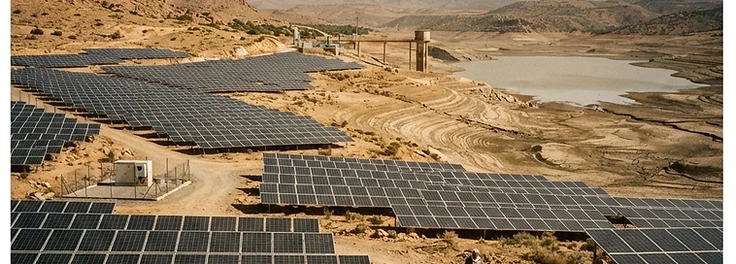
Energy is bound up in all of this. Desalination and pumping use a lot of electricity, and Tunisia's share of renewables remains in the low single figures against a target of 30 per cent by 2030. A country that must desalinate with costly imported fuel, while leaving its own sun and wind largely unused, pays twice.
Waste closes the circle. Landfill siting has repeatedly failed, most visibly in Sfax, where collection broke down and rubbish piled in the streets. Towns cannot pay the full cost of collection, and the national agency cannot build facilities that local people refuse.
The human dimension
Water rationing costs time before it costs money.
A household with a tank fills it when supply comes and rations it afterwards. Cooking, washing and cleaning are scheduled around the hours the utility announces. When the tank empties, the household buys from a tanker and pays several times the piped price for the same water.
The burden falls unevenly. Women carry most of the work of managing household water. Families without storage or income to buy supplementary supply are the most exposed. And rural households wait longest for networks, while their farming neighbours face restrictions that city residents never see.
Refuse collection is the same story in another form. Where collection stops, the effects concentrate in dense neighbourhoods with the least space to store waste, and in low-lying areas where runoff and leachate collect.
Energy delays are felt at a distance, as a cost on a bill and as pressure on a national budget that could otherwise fund the water networks.
The contributor's account of Sfax, Djerba and the rural interior is testimony and is treated as such. The national figures used here come from published statistics and are cited separately.
The legal and policy framework
Water Code, Law No. 75-16 of 1975
- Legal foundation
- Tunisia's main water law, passed in 1975 and amended since. It makes water a public resource, requires permits for large abstractions, and sets priorities between uses, with drinking water first.
- Substantive obligations
- Anyone abstracting above set limits needs authorisation. The state plans and allocates water by region and sector.
- Institutional responsibilities
- The ministry responsible for water and agriculture sets policy. Regional development commissariats issue permits and run irrigation. The national utility supplies drinking water.
- Enforcement mechanisms
- Permits, meters, tariffs and administrative penalties. Enforcement against unlicensed wells is limited by the number of drilling sites and by the political cost of restricting farm water.
- Implementation gap
- The Code was written for a wetter era and a mostly public supply system. Reform proposals have circulated for years to strengthen groundwater rules, but a revised code has not been passed. It should not be described as modernised.
- Environmental justice implications
- Drinking water is first in law. In practice, the household that is connected and can afford a tank is served, and the household that is neither is not.
Framework Law No. 2015-12 on renewable electricity
- Legal foundation
- A 2015 law allowing private companies to generate renewable electricity for their own use, for sale to the national utility, and for export.
- Substantive obligations
- Projects need authorisation or a concession depending on size, must meet grid connection requirements, and operate under contract with the utility.
- Institutional responsibilities
- The energy ministry sets policy and awards authorisations. The national energy agency promotes efficiency and renewables. The state utility runs the grid.
- Enforcement mechanisms
- Authorisations, connection agreements and contractual conditions.
- Implementation gap
- Delivery has fallen far short of the national target. The documented obstacles are administrative: long authorisation times, limited grid access, and a utility that both controls the grid and competes in generation.
- Environmental justice implications
- The cost of delay is paid by consumers through fuel imports, and by inland regions where grid capacity is weakest and new projects could create local work.
Waste law, Law No. 96-41 of 1996, and the national waste agency
- Legal foundation
- Sets the framework for waste management and created, in 2005, a national agency responsible for planning and building treatment and disposal facilities.
- Substantive obligations
- Municipalities collect waste. The agency sites, builds and runs facilities. Operators must hold permits.
- Institutional responsibilities
- The national waste agency, the environment ministry, governorates, municipalities and private contractors.
- Enforcement mechanisms
- Operating permits, environmental assessment requirements and municipal contracts with penalties — all of which assume functioning facilities and towns that can pay.
- Implementation gap
- The law created institutions without securing the two things they need: acceptable sites and reliable municipal funding. When a landfill is blocked, waste has nowhere lawful to go.
- Environmental justice implications
- Communities near a proposed facility carry the burden of a service used by the whole governorate, and their objections have been treated as obstacles rather than as a siting problem to be negotiated.
Environmental impact assessment and public inquiry
- Legal foundation
- Certain categories of project must have an environmental impact assessment, and some must go through a public inquiry.
- Substantive obligations
- Developers commission an impact study, submit it for approval, and accept conditions.
- Institutional responsibilities
- The environment ministry and its regional offices, the environmental protection agency, and the sectoral ministry.
- Enforcement mechanisms
- Approval conditions and inspection, with limited capacity to check compliance after approval.
- Implementation gap
- Consultation comes late, after the site is chosen and the design fixed. That turns a real question — where should this go — into an objection to a decision already taken.
- Environmental justice implications
- Fairness in procedure is decided by timing. A consultation held after siting grants a hearing but not influence.
National drought and climate adaptation policy
- Legal foundation
- National strategies set out water demand management, desalination, reuse of treated wastewater and drought adaptation, and are revised periodically.
- Substantive obligations
- These are policy commitments, not duties enforceable by a citizen: targets, programmes and coordination.
- Institutional responsibilities
- The water, environment and energy ministries, working through national climate structures and sectoral plans.
- Enforcement mechanisms
- Budget allocation and administrative oversight.
- Implementation gap
- Desalination and wastewater reuse are expensive and energy-hungry. The adaptation chosen therefore raises electricity demand at the moment the country is trying to cut its import bill.
- Environmental justice implications
- Adaptation that depends on purchased energy shifts the cost to households through tariffs, which hits the poorest hardest unless it is deliberately offset.
- Water Code, Law No. 75-16 of 1975, as amended
- Framework Law No. 2015-12 on renewable electricity production
- Law No. 96-41 of 1996 on waste management and the National Waste Management Agency
- Environmental impact assessment and public inquiry requirements
- National drought management and climate adaptation policy
The psychology of environmental injustice
Living with too little water changes how people think, in ways that are often read as resignation.
The first change is attention. Research on scarcity finds that coping with an insufficient resource uses up mental capacity. A household managing an intermittent supply is not indifferent to conservation; it is occupied by the logistics of the next delivery.
The second is a sense of control. When supply depends on a utility, a ministry and a tanker driver, an individual's efforts to save water have no visible effect. Studies of behaviour consistently find that people act when they believe their action matters. Advice to save water, given to a household using a fraction of what the network loses and the farms abstract, can be heard as an accusation.
The third is trust. Rationing is run by institutions whose competence becomes visible exactly when things go wrong. A quota announced with no explanation, or a collection service that stops for months, changes confidence sharply rather than gradually.
The fourth is fairness. Research on regulation finds that people accept unwelcome restrictions far more readily when they believe the process was fair and the reasoning explained. The same quota, explained as an allocation with stated criteria, is received differently from a directive.
The contributor's description of institutional bottlenecks is a hypothesis about administration, not a survey of public opinion, and it should be tested rather than assumed.
Environmental justice analysis
Start with who gets water. Tunisia gives drinking water priority in law, but access depends on a connection, a tank and money. Households buying from tankers pay many times the piped tariff, so the worst-served customers pay the most per litre. That pattern is common across the region and it is regressive by construction.
Then look at waste. When communities near proposed landfills have objected, the objection has been treated as a local obstacle to a provincial need, rather than as evidence that the siting process lacked negotiation, compensation and credible safeguards. The result is a system that cannot place its own infrastructure.
Inland and rural regions carry a third burden. Their water and grid service lags the coast, even though their farms supply much of the country's food.
Future generations appear twice. Over-pumping coastal aquifers lets salt in, which destroys the resource for everyone who comes after. And choosing energy-intensive desalination commits future budgets to a fixed running cost.
Energy fairness closes the loop. A country with strong sun and weak renewable generation is effectively importing the power it could make, and households pay for that through tariffs and the state pays through subsidies.
Institutions and accountability
Authority is split by design. Water belongs to the ministry of agriculture, a national supply utility and regional commissariats. Energy belongs to a separate ministry and a state utility that runs the grid and also generates power. Waste belongs to a national agency, governorates and municipalities with separate budgets.
The results follow predictably. Water policy cannot require energy policy to act, so desalination is approved without matching renewable capacity. Waste policy cannot make towns pay, so facilities run below capacity. Renewable policy cannot force a grid connection, so authorised projects wait.
Real progress has been made: metering and tariff reform, new desalination capacity, a legal route for private renewables, and a national agency with a coherent plan.
What is missing is one body responsible for all three, a published method for deciding who gets water, an agreed process for siting facilities with negotiated compensation, and a binding schedule for renewables. None of that requires new water. Each requires a decision about who decides.
Tunisia's water problem is not caused by rainfall alone. It is caused by three institutions each managing one resource while the shortage runs across all three. Water, power and waste are one system seen from three angles, and a state that runs them separately will keep finding the same failure in a new place.
Evidence base
Compiled from the public record. Contributor observations are not included here.
Tunisia's renewable fresh water is estimated at roughly 400 to 450 cubic metres per person a year, below the 500 cubic metre threshold for absolute scarcity (FAO AQUASTAT and national estimates).
Documented evidenceNational dam storage fell to roughly a quarter of capacity during 2023, prompting quota rationing by the water utility (government reporting, 2023).
Documented evidenceRenewables supply a low single-digit share of Tunisia's electricity against a national target of 30 per cent by 2030 (national energy strategy and international energy statistics).
Documented evidenceLaw No. 2015-12 opened the way for private renewable generation for self-consumption, sale and export (statutory text).
Documented evidenceLaw No. 96-41 sets the waste management framework, and the national waste agency was created in 2005 (statutory and agency records).
Documented evidence
- March 31, 1975Water Code adopted, making water public and requiring permits.
- June 10, 1996Waste management framework law adopted.
- January 1, 2005National Waste Management Agency established.
- May 11, 2015Renewable electricity framework law adopted.
- April 1, 2023Dam storage falls to about a quarter of capacity; quotas introduced.
Renewable freshwater per person, against two thresholds
Scarcity is not a metaphor here. It is a ratio, and Tunisia has been below the conventional scarcity line for years.
- Tunisia, latest available estimate≈400 m³
Figure rounds a national average; internal regional variation is large, and the south is drier than the north.
- Water scarcity threshold500 m³
The widely used threshold below which a country is considered to face absolute water scarcity.
- Water stress reference level1,700 m³
The level below which periodic or limited water shortages are considered likely.
At roughly 400 m³ per person, the constraint is structural. It shapes what agriculture can grow, what cities can supply, and which industries can be licensed.
Source: World Bank / FAO water indicators, latest available year. Values are national averages and are shown to two significant figures because the underlying estimates carry uncertainty.
One system, three faces
Water, energy and waste are managed by separate institutions but are physically connected.
Groundwater and dam storage supply cities and irrigation. Over-abstraction lowers aquifers and can draw in saline water in coastal areas.
Nexus description is a schematic compiled from institutional mandates and published sector analysis. It is not a site-specific measurement.
Instruments that govern scarcity
Tunisia's legal framework is older than the crisis it now has to manage.
Water Code
Declares water a public good, establishes abstraction permits and the framework for dam and groundwater management.
Implementation gap: Permitting has coexisted with extensive unpermitted groundwater use, particularly for irrigation — a gap acknowledged in sector reporting.
Legal instruments described from their official texts and reporting. Dates of amending instruments should be checked against the current consolidated code.
Who carries the shortage
Scarcity is allocated through institutions, and institutions allocate unevenly.
Small farmers and agricultural labourers
Irrigation-dependent and exposed to quota enforcement and rising pumping costs, with limited ability to switch crops quickly.
Low-income urban households
Face restricted supply and the cost of storing and hauling water when pressure drops.
National water utility
Manages supply and tariffs under financial strain, including high non-revenue water losses.
Energy and water ministries
Set tariffs, subsidy and investment priorities that determine how water and energy are priced against each other.
Waste collection authorities
Hold a mandate that directly affects groundwater quality, but have limited capacity for enforcement.
Sources & further reading
- World Bank Open Data — renewable internal freshwater resources per capitaWorld Bank, 2024 · official statistics
- Water resources in TunisiaWorld Bank, 2023 · official analysis
- Renewable energy law and institutional frameworkAgence Nationale pour la Maîtrise de l'Énergie, 2024 · institutional record
- Waste management in TunisiaAgence Nationale de Gestion des Déchets, 2024 · institutional record
Links open the publisher's own page. Figures are quoted with their year and scope; where evidence is contested or incomplete, the story says so rather than filling the gap.
Similar stories around the world



Contributors may withdraw permission or request corrections at any time. Request a correction.