The Carbon Capture Paradox
Britain is spending billions to capture carbon and bury it under the North Sea. The technology works. Whether the policy does is a different question.
This feature combines EJA's analysis with cited public sources. Contributor observations are labelled as such, figures are given with their year and scope, and sources are listed at the end.
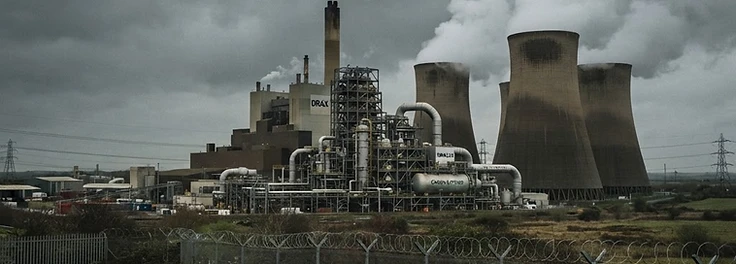
On Teesside and along the Humber, the landscape of heavy industry is being rebuilt around a new idea. Steel, chemicals and cement plants that have operated for a century would keep operating, with one change: instead of releasing carbon dioxide into the air, they would capture it, compress it and send it under the North Sea.
The government has committed up to twenty billion pounds to make this happen. Two industrial clusters have been selected to go first. Pipelines are planned, storage licences issued, and the first contracts signed.
The argument is straightforward, and it is not wrong. Some industrial processes — making cement, refining steel, producing hydrogen from gas — release carbon dioxide as a chemical consequence of the process, not just as a by-product of burning fuel. For those, capture is close to the only way to keep the plant running and cut emissions.
The complication is what happens around the plant. Carbon capture uses energy, and today most of that energy comes from gas. The electricity grid must grow to supply it. The pipelines must be built across farmland and coastline. And a technology that makes it possible to keep a plant open also makes it possible to keep it open longer than the climate needs.
This story looks at the gap between what the law requires and what the subsidy pays for.
The environmental problem
Carbon capture and storage separates carbon dioxide from other gases, compresses it, and pipes it to a geological formation where it is intended to stay permanently.
Each step has an energy cost. Capturing the gas takes power; compressing and transporting it takes more. The net saving in emissions is therefore always less than the amount captured, and how much less depends on the energy source used. A capture project powered by unabated gas can save far less than its headline figure suggests.
The storage side is better established than the capture side. Depleted gas fields and saline aquifers under the North Sea have held gas and brine for millions of years, and the geology is well understood. Monitoring obligations extend over decades.
The harder questions are about system effects. A pipeline network built for a cluster must be sized for future customers as well as current ones, which means public money pays for capacity others will use. And because carbon capture is expensive per tonne, it competes for the same budget as insulation, heat pumps and renewable generation, which in most studies deliver more abatement for the same money.
Then there is the political effect. A plant with a capture system has a future, and that future is created by policy. Whether it also delays the retirement of the plant, or the plant's replacement by something cleaner, is a question the subsidy does not answer.
The human dimension
For the workers in these industries, the argument is personal and immediate.
A steelworks in Port Talbot or a chemicals plant on Teesside is not only an employer. It supports suppliers, apprenticeships, a football club, a high street. Closure costs are paid in a town, not on a balance sheet.
That is why carbon capture has political support in the places where it is being built. It offers continuity: the same site, the same workforce, a different pipe. Workers who have watched plants close elsewhere are understandably reluctant to treat a promised technology as a threat.
The residents along the pipeline routes have a different experience. Construction brings years of works, traffic and compensation negotiations. Some landowners object; others accept. Risk perception matters here: pipelines carrying carbon dioxide behave differently from gas pipelines, because a leak of dense carbon dioxide can pool in low ground and is hazardous in a way that is not intuitive.
And there is the question that does not go away. If the plants keep running because the subsidy keeps them running, the community's transition has been postponed, not resolved, and the next closure will arrive with less warning.
The contributor's concern, which prompted this entry, is whether the policy is protecting jobs or protecting emissions. That is a question the published record can partly answer.
The legal and policy framework
Climate Change Act 2008 and the carbon budgets
- Legal foundation
- Sets a legally binding duty on government to reduce emissions and meet five-yearly carbon budgets on the way to net zero.
- Substantive obligations
- Government must set and meet carbon budgets and report progress. The duty is on the state, not on individual installations.
- Institutional responsibilities
- The Climate Change Committee as statutory adviser, the government departments responsible for energy and industry, and Parliament through the budget-setting process.
- Enforcement mechanisms
- Statutory reporting, independent advice and judicial review. The Act does not compel any specific measure, which means a capture subsidy and a renewable programme are equally compatible with it.
- Implementation gap
- The Act sets the destination but not the route. Whether public money buys the cheapest abatement is a policy judgement the Act does not test.
- Environmental justice implications
- The Act counts tonnes, not people. It has no mechanism to weigh a town's employment against the cost of abating more cheaply elsewhere.
Energy Act 2023 and the carbon capture licensing regime
- Legal foundation
- Creates the statutory framework for carbon transport and storage, including licensing by the North Sea Transition Authority, revenue support for transport and storage operators, and the legal basis for the business models that pay for them.
- Substantive obligations
- Operators must hold licences, meet safety and environmental conditions, and comply with monitoring requirements that outlast commercial operation.
- Institutional responsibilities
- North Sea Transition Authority, the energy regulator, the health and safety executive, and the energy ministry.
- Enforcement mechanisms
- Licensing conditions, monitoring obligations, and financial support agreements with clawback provisions.
- Implementation gap
- The regime regulates the geological storage, not the emission reduction. A licensed, well-run storage site is compatible with a capture plant that barely reduces emissions, because the two are authorised under different instruments.
- Environmental justice implications
- Long-term storage liability is a commitment made by present taxpayers to a future generation, and the finance behind it is a public subsidy agreement.
Environmental permitting and emissions trading
- Legal foundation
- Operators must hold permits limiting emissions, and large installations participate in the UK emissions trading scheme.
- Substantive obligations
- Permit conditions and the surrender of allowances for emissions released. Installations with capture may receive free allowances or support to reflect the extra cost.
- Institutional responsibilities
- Environmental regulators, the scheme administrator and the devolved administrations.
- Enforcement mechanisms
- Permit conditions, monitoring and civil penalties, with trading providing the price signal.
- Implementation gap
- The carbon price has been volatile and, at times, too low to drive abatement on its own, which is why subsidy rather than price has become the main instrument. Subsidy without a strict condition on net performance rewards the appearance of abatement.
- Environmental justice implications
- If allowances are allocated to cover the energy cost of capture, part of the public subsidy is paid twice: once in funding and once in allowances.
Planning and infrastructure consent
- Legal foundation
- Pipelines, plants and storage facilities require planning consent, with major projects decided under the national infrastructure regime.
- Substantive obligations
- Developers must submit environmental assessments, consult affected communities, and meet conditions attached to consent.
- Institutional responsibilities
- The planning inspectorate, the responsible secretary of state, local authorities and statutory consultees.
- Enforcement mechanisms
- Consent conditions, compulsory purchase powers and compensation for affected landowners.
- Implementation gap
- Assessment is project-specific. The cumulative effect of a pipeline network, several plants and associated power demand is not assessed as a whole, and the power demand is often met outside the consenting process entirely.
- Environmental justice implications
- Landowners on the route carry the disruption, and the communities hosting the plants carry the residual risk, while the climate benefit is national and global.
Subsidy agreements and the industrial decarbonisation strategy
- Legal foundation
- Public funding is provided through negotiated support agreements with cluster operators, alongside a strategy for industrial decarbonisation.
- Substantive obligations
- Funding is conditional on delivery milestones, with clawback if projects fail.
- Institutional responsibilities
- The energy ministry, the industrial decarbonisation body, and the operator companies.
- Enforcement mechanisms
- Milestone reporting, independent audit and contractual clawback.
- Implementation gap
- The central test — how much carbon is avoided per pound spent — is not the basis on which agreements are publicly evaluated. Comparison with alternative uses of the same money is rarely published.
- Environmental justice implications
- Twenty billion pounds committed to one pathway is a choice not to spend it on another, and the people who would have benefited from the alternative are not part of the decision.
- Climate Change Act 2008 and the statutory carbon budgets
- Energy Act 2023 and the carbon capture, transport and storage licensing regime
- Environmental permitting and the UK Emissions Trading Scheme
- Nationally significant infrastructure planning and environmental assessment
- Public subsidy agreements and the industrial decarbonisation strategy
The psychology of environmental injustice
Carbon capture is a technology that people judge as an idea rather than as an engineering system, and that changes everything about how it is received.
Research on policy support finds that technologies associated with continuing fossil fuel use attract suspicion even when their numbers are good. The objection is not usually about the efficiency of an amine solvent. It is about what the technology appears to promise: that nothing has to change.
For the communities hosting it, the same fact reads differently. Continuity is the point. A promise that the plant stays open is not a moral compromise; it is next year's wages and a viable town. Both groups are reasoning correctly from the information they have.
There is also a trust problem specific to promises about the future. Voters have heard decades of projections about nuclear, hydrogen and clean coal. Each cycle leaves a residue, and the residue produces a bias towards expecting failure. This is not unreasonableness; it is learning from experience.
And there is a psychological asymmetry in how risk is weighed: a subsidised technology that might not work receives more scrutiny than an existing risk that certainly does harm, because the first is new and the second has become background.
None of these patterns tells us whether the policy is sound. They explain why the public argument is louder than the technical one.
Environmental justice analysis
Three claims are in tension.
The first is climate. Money spent on capture could abate more carbon elsewhere. If it does not, the people who pay the cost of a slower transition are those most exposed to climate change, at home and abroad, who have no say in the decision.
The second is employment. A just transition is supposed to protect workers, and a policy that keeps a plant running does protect them — for as long as the subsidy lasts. The risk is that it converts a transition into a deferral, and the deferral into an eventual closure for which no one has prepared.
The third is public money. Twenty billion pounds is committed to a pathway before a rigorous comparison with alternatives has been published. The people who will pay that are taxpayers, including those in regions that received nothing.
There is a procedural dimension. Where the pipeline runs, consent is decided nationally and disruption is local. Where the plant sits, the emissions benefit is national and the residual risk is local. Neither group is asked to accept the arrangement; both are asked to live with it.
And there is an intergenerational dimension that is unusual. Storage must be monitored for decades after the last plant closes, and the liability falls to the public. That is a promise made now by people who will not be present to keep it.
Institutions and accountability
The framework is genuinely thorough. A statutory climate duty sets the target, a licensing regime governs storage, environmental permits govern emissions, planning governs construction and contract law governs the money.
Each instrument has an owner: the Climate Change Committee advises, the storage regulator licenses, the environmental regulators permit, the planning inspectorate examines and the energy ministry pays.
What no instrument does is test the sum. That a storage site is well licensed says nothing about whether the plant above it cut emissions by the amount claimed. That a carbon budget is met nationally says nothing about whether it was met at the lowest cost. That a milestone was hit says nothing about whether the alternative use of the money would have done better.
The reforms that would close the gap are administrative rather than technical: require every subsidised capture project to publish its measured net removal, not its design figure; assess clusters cumulatively rather than project by project; and publish the comparison with alternative abatement before committing public money.
None of these has been done, and each would show quickly whether the policy is delivering what it promised.
Carbon capture is not a fantasy. The engineering is real and the geology is sound. The question is what it is used for: to remove emissions that have no other route, or to postpone decisions that would cost more political capital. A subsidy can buy either. Only measurement tells you which one you bought.
Evidence base
Compiled from the public record. Contributor observations are not included here.
The UK government has committed up to twenty billion pounds to carbon capture, usage and storage across selected industrial clusters (government announcements, 2023–2025).
Documented evidenceCarbon capture requires energy for separation, compression and transport, so net emission reductions are lower than the quantity captured (technical literature and project data).
Documented evidenceTwo industrial clusters were selected in the first phase, with pipelines and North Sea storage licences progressing under the Energy Act 2023 (regulatory records).
Documented evidenceCarbon capture is among the only available routes to reduce process emissions from cement and some chemicals production (industrial decarbonisation studies).
Documented evidenceThe Climate Change Committee has advised that the programme should be measured against alternative abatement options on cost-effectiveness (independent advisory reports).
Documented evidence
- November 26, 2008Climate Change Act makes emission reduction a statutory duty.
- November 1, 2020Government sets out its ten point plan, including carbon capture in industrial clusters.
- October 26, 2023Energy Act establishes the carbon transport and storage licensing framework.
- October 4, 2024Up to twenty billion pounds committed to the first capture clusters.
Follow one tonne of carbon dioxide
The word 'capture' hides four separate steps, each with its own losses and its own regulator.
CO₂ is separated from flue gas using chemical solvents. Typical design capture rates for power and industrial plants are in the region of 85–95 per cent — not 100 per cent, so the uncaptured share still reaches the atmosphere.
Step descriptions from published CCUS engineering literature and the UK's CCUS programme documents. Capture rates are design ranges and vary by plant type.
Ambition against operational reality
The UK's target is stated in millions of tonnes per year. The comparison below is deliberately uncomfortable: it is the gap the policy has to close.
- 2030 target — upper end20–30 Mt
Government ambition for captured and stored CO₂ by 2030.
- 2030 target — lower end20 Mt
The lower bound of the same ambition.
- Large-scale operational storage today≈0 Mt
The first Track-1 projects are at construction and negotiation stage; the UK has no large-scale operational CO₂ storage as of the last review.
A target of 20–30 Mt a year has to be built from a standing start, which makes delivery risk a policy fact rather than a criticism.
Sources: UK Government CCUS programme documents; Climate Change Committee progress reporting. The operational figure is approximate and should be re-checked against the latest project status.
The legal scaffolding beneath the target
Carbon capture needed new law to exist at all: who may store CO₂, under the seabed, and who is liable if it leaks.
Climate Change Act
Creates binding carbon budgets and, after the 2019 amendment, a net-zero target for 2050.
Implementation gap: The Act sets the destination. It does not require any particular technology, and governments have repeatedly been criticised for lacking a delivery plan.
Design an incentive — and watch what it rewards
Policy instruments change behaviour, including behaviour nobody intended.
You are advising on a subsidy that pays per tonne of CO₂ captured and used. Which design risk would you flag first?
Illustrative reasoning about incentive design. It reports no data and no participant responses; the trade-offs described are drawn from published policy analysis.
Sources & further reading
- Carbon Capture, Usage and Storage collectionUK Government, 2024 · official policy
- Climate Change Act 2008The National Archives, 2008 (as amended 2019) · legislation
- Energy Act 2023The National Archives, 2023 · legislation
- CCUS in the transition to net zeroInternational Energy Agency, 2024 · official analysis
Links open the publisher's own page. Figures are quoted with their year and scope; where evidence is contested or incomplete, the story says so rather than filling the gap.
Similar stories around the world




Contributors may withdraw permission or request corrections at any time. Request a correction.