The Burden of a Radioactive Future
France's nuclear plants produce a small amount of waste that stays dangerous for a very long time. The law decides who is responsible, and for how long.
This feature combines EJA's analysis with cited public sources. Contributor observations are labelled as such, figures are given with their year and scope, and sources are listed at the end.
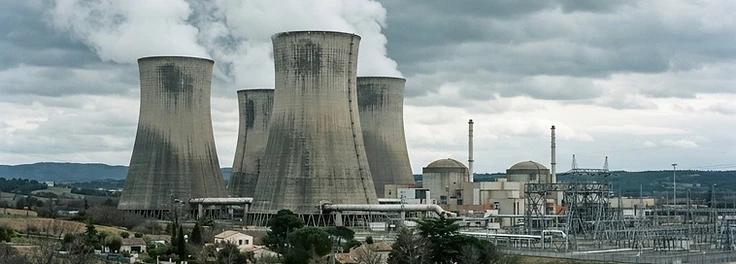
At La Hague, on the coast of Normandy, spent nuclear fuel sits in pools of water several metres deep. The water shields workers from radiation that would be lethal within minutes at close range. It also carries away heat that will keep coming for years.
France gets most of its electricity from nuclear power and has done so since the 1980s. That choice left behind a waste problem that is small in size and enormous in duration. The national inventory counts around 1.6 million cubic metres of radioactive waste of all kinds. The most dangerous category is less than one per cent of that volume and the overwhelming majority of the radioactivity.
This is the whole difficulty in one sentence: a tiny amount of material determines almost all of the risk, and what to do with it commits institutions that do not yet exist.
Nuclear waste is therefore governed more by law than by engineering. The law decides what counts as waste, who must plan for it, how far ahead, who is consulted, and — the question that matters most — when responsibility passes from the company that sold the electricity to the state that will watch over the site for centuries afterwards.
This story is not about whether France should use nuclear power. It is about whether the rules for its waste match the timescale of the hazard, and who ends up carrying the difference.
The environmental problem
Radioactive waste is not one thing. It is a set of categories, defined by how radioactive it is and how long it stays that way, and the category decides everything about how it is handled.
High-level waste is the residue of reprocessing spent fuel. It is intensely radioactive, it produces heat, and it must be cooled and shielded for decades. It stays hazardous far longer than any human institution has lasted.
Intermediate-level waste needs shielding but not cooling. Low-level waste is bulky and short-lived and is buried in surface facilities.
France's approach has combined three things: reprocessing, temporary storage and a planned deep repository. Reprocessing separates reusable plutonium and uranium from the fission products, which shrinks the volume of high-level waste and changes its form.
Temporary storage is not a solution but a delay. Pools and dry stores are engineered to be safe for decades, and their safety depends on people paying attention: replacing equipment, maintaining cooling, keeping the institution solvent.
The repository, known as Cigéo, is planned in clay about 500 metres under Bure in eastern France. Waste would be placed underground, and the facility would stay open and reversible for roughly a century before being sealed. Reversibility is a political idea as much as an engineering one: it lets a future generation retrieve the waste or change its mind.
Two limits on the evidence should be stated plainly. No deep repository for high-level waste is yet operating at full scale anywhere in the world, so the safety case rests on modelling and underground research rather than on decades of operation. And what counts as waste is a legal and economic decision as much as a physical one: material classified as recyclable fuel is not counted as waste.
The human dimension
For the villages around Bure, the repository is not a diagram. It is a construction site, an employer, and a permanent industrial presence in a rural area of farms and small towns.
Opinion there has been split for twenty years. Supporters point to jobs, to compensation, to a national problem being solved somewhere. Opponents point to the lorries carrying waste through their villages, to a decision they cannot reverse, and to the fact that no one alive today can be held to a promise about a site that will be sealed in a hundred years.
Both groups live there. Neither is a caricature, and both have been surveyed, consulted and recorded at length.
Workers inside the industry carry a more direct stake. Dose limits, monitoring and the safety of the most hazardous operations are matters of daily practice, and their exposure is governed by standards that are revised over time.
For everyone else, the stake is time. People now benefiting from low-carbon electricity benefit from the arrangement that produced the waste. Almost nobody now living will be there when the site is sealed, and nobody now living will be there if it fails.
The contributor's concern — that responsibility has been moved rather than settled — is a question that can be checked. It is a question about what the law assigns, to whom, and when.
The legal and policy framework
Law No. 2006-739 of 28 June 2006 on radioactive materials and waste
- Legal foundation
- The programme law that sets France's framework for managing radioactive waste. It defines the categories, requires a national plan, and sets out deep geological disposal and the principle of reversibility.
- Substantive obligations
- The state must maintain a national management plan, the repository must be authorised before operation, and reversibility is a condition of that authorisation rather than an optional extra.
- Institutional responsibilities
- The energy and environment ministries share policy. The national waste agency is the industrial operator. The nuclear safety regulator authorises. An independent scientific body reviews the safety case.
- Enforcement mechanisms
- Authorisation by decree after safety review and public consultation, with continuing oversight afterwards.
- Implementation gap
- The law commits France to a repository. The repository is not yet operating, so the safety case currently rests on modelling. That is not a breach; it is the state of the evidence.
- Environmental justice implications
- Reversibility is a justice provision. It preserves a future generation's ability to reconsider. It only works if the means to reverse — money, records, skills — are preserved too.
Environmental Code rules on radioactive substances
- Legal foundation
- Codifies licensing of nuclear installations, waste obligations, and the requirement for a national inventory and plan.
- Substantive obligations
- Operators must hold authorisations, maintain safety cases, report incidents, and finance decommissioning and waste management.
- Institutional responsibilities
- The nuclear safety regulator, prefectural authorities for certain consents, and the operator, which is legally responsible for its own waste.
- Enforcement mechanisms
- Licensing conditions, inspection, administrative sanctions and criminal penalties. The regime is strict; its weakness is not stringency but duration.
- Implementation gap
- Operators must set aside money for future costs, assessed against estimates. Whether those estimates are adequate can only be tested decades from now.
- Environmental justice implications
- If the estimate is too low, the shortfall moves to the public purse and to taxpayers who had no part in the original decision.
National Radioactive Materials and Waste Management Plan
- Legal foundation
- A national plan, revised at intervals, setting out the inventory, the route for each waste category, the facilities needed and the research required.
- Substantive obligations
- The plan commits the state to a schedule of facilities and to conditions for their authorisation, and is subject to public consultation and independent review.
- Institutional responsibilities
- The energy and environment ministries jointly own it. The waste agency supplies the inventory. The safety regulator issues an opinion.
- Enforcement mechanisms
- Adoption of the plan, parliamentary scrutiny, and the authorisation process for each facility. Slippage is the visible form of failure.
- Implementation gap
- Successive editions have slipped against their own schedules, particularly on storage capacity and the repository. Each delay is absorbed by keeping the waste in temporary storage for longer.
- Environmental justice implications
- Delays pass the burden to the current generation of workers and host communities, and postpone the moment when the public can judge whether the long-term answer is credible.
Public debate and consultation procedures
- Legal foundation
- Major nuclear decisions are subject to public debate under national participation rules, with a local information and oversight commission at the site.
- Substantive obligations
- The state and developer must publish documentation, answer questions from the independent commission, and hold debates before authorisation stages.
- Institutional responsibilities
- The national commission for public debate, the local oversight commission, the regulator and the operator.
- Enforcement mechanisms
- Procedural: a decision taken without the required consultation is open to legal challenge, and the debate record forms part of the authorisation file.
- Implementation gap
- Consultation gives a voice, not a veto. Local opinion is recorded and considered, but the decision stays national. That gap is the source of much of the opposition at Bure.
- Environmental justice implications
- Being heard without being able to decide is a partial form of justice. Host communities are consulted and compensated while the decision rests on national need.
- Law No. 2006-739 of 28 June 2006 on sustainable management of radioactive materials and waste
- Environmental Code provisions on radioactive materials and waste
- National Radioactive Materials and Waste Management Plan (PNGMDR)
- Public consultation and environmental assessment requirements
- Institutional mandates of the waste management agency and the nuclear safety authority
The psychology of environmental injustice
People do not assess nuclear risk the way they assess a car journey, and the reasons are well documented.
Research on risk perception finds that hazards seen as involuntary, invisible, catastrophic and delayed are judged far more alarming than their frequency would suggest. Nuclear waste scores high on every one of those. This is not a failure to understand the numbers; it is how people reason about outcomes that cannot be undone.
Time works strangely here. People systematically weigh present costs more heavily than future ones, and the effect is not simple selfishness: consequences centuries away are less vivid and feel less real.
Trust then does most of the work, because the safety case can only be judged through institutions. Studies of regulatory legitimacy find that trust depends less on technical competence than on openness, on admitting uncertainty, and on how credible the critics are treated as being. An operator presenting a flawless case tends to reduce trust, not raise it.
Consultation has a trap of its own. Being asked, recorded and then overruled can leave people more disillusioned than not being asked at all, because it demonstrates that their view does not change the outcome.
Finally, framing matters. Describing the waste as an inheritance rather than a disposal problem changes how people reason, because it draws on obligations they already feel towards their own children.
None of this tells us what the residents of Bure think. Their views are documented elsewhere, and the contributor's concern is a claim about law, which is examined as law.
Environmental justice analysis
The clearest question is between generations. The present generation gets the electricity. The generations that follow get the monitoring duty. A repository is meant to make that duty passive rather than active, which is exactly why its credibility matters more than its cost.
For the host area, the exchange is compensation, jobs and infrastructure in return for hosting a national facility. Whether that is fair depends on whether the burden can be measured at all: an accident is not a cost that money paid in advance can settle.
Procedure is where France is strongest and most contested. Consultation is thorough, published and independent. The decision remains national. Communities asked to host a facility for a century deserve to know whether they are being offered a veto or a hearing.
The workforce also deserves mention. Its exposure is governed by limits set by regulators rather than negotiated with the people who carry it.
There is an international dimension too, rarely discussed at home. Countries that send fuel to France for reprocessing leave their residues in French ground, which concentrates other nations' waste in one place.
The fairest conclusion is procedural rather than substantive. The framework assigns responsibility clearly and reviews it repeatedly, and whether it is adequate will be shown only by institutions that outlast the people who built them.
Institutions and accountability
Responsibility is unusually explicit. The operator is legally responsible for its own waste and must pay for its management. The national waste agency is the industrial operator and keeps the inventory. The safety regulator can refuse authorisation. An independent scientific body reviews the research. The state sets policy through law, the plan and the authorisation decree, and the state ultimately takes responsibility for a sealed site.
The architecture is coherent. Its weaknesses are time and money. The money set aside is based on estimates of costs decades away, and there is no way to check them now. The monitoring obligations outlast any institution that has been demonstrated to last, and the transfer of liability after closure is a promise the state makes to a future it cannot bind.
Real work has been done: a statutory framework since 2006, a national inventory and plan revised at intervals, independent review, public debate, and twenty years of site research in an underground laboratory.
What is unresolved is whether the timetable holds — storage capacity keeping pace with the inventory, the repository opening on schedule, the safety case published with its uncertainties intact, and the eventual transfer of liability properly funded. Each has a named institution responsible for the answer, and each answer is public.
A radioactive atom does not negotiate. It decays on a timetable that ignores elections, budgets and changes of management, and the only instrument a society has for that timetable is law. The question of nuclear waste is therefore a question about time: whether a generation that takes the electricity can be held to the obligation afterwards, and whether the generation that inherits it gets anything more than a monitored site and a promise.
Evidence base
Compiled from the public record. Contributor observations are not included here.
The French national inventory records around 1.6 million cubic metres of radioactive waste, with high-level waste under one per cent of the volume and the large majority of the radioactivity (national inventory).
Documented evidenceLaw No. 2006-739 of 28 June 2006 sets the national framework, requires a deep geological repository, and makes reversibility a condition of authorisation (statutory text).
Documented evidenceCigéo is planned in clay roughly 500 metres below Bure, with an operating and reversible phase of about a century before closure (national waste agency project documents).
Documented evidenceNo deep geological repository for high-level radioactive waste is yet operating at industrial scale anywhere in the world (international nuclear reporting).
Documented evidenceOperators must set aside funds for decommissioning and waste management, assessed against cost estimates that are reviewed periodically (statutory text).
Documented evidence
- December 30, 1991First waste research law sets three research routes, including deep disposal.
- June 28, 2006Programme law sets the framework and requires a repository.
- January 1, 2013National commission for public debate holds consultations on the project.
- January 1, 2022Later editions of the national plan continue to schedule repository milestones.
The waste lifecycle, in five stages
Each stage has a different owner, a different regulator, and a different timescale.
Spent fuel is removed from reactors and stored in cooling pools. Most of the radioactivity is created here, in a fuel assembly weighing under a tonne.
Lifecycle described from ANDRA and ASN public documentation. Descriptions are simplified and do not represent a specific facility design.
High-level waste: a small share of volume, almost all of the radioactivity
Two figures that explain why volume is the wrong measure of the problem.
- Share of total radioactive waste volume≈10%
High-level waste is a minor fraction of the total mass and volume produced since the industry began.
- Share of total radioactivity≈99%
It accounts for nearly all the radioactivity, which is why its disposal dominates the long-term obligation.
A facility can be small and still carry a thousand-generation obligation. This is the mismatch at the centre of the French debate.
Source: ANDRA national inventory and the French regulatory programme. Percentages are commonly cited national figures and are rounded; definitions of the 'high-level' category differ between countries.
Three laws that built the French solution
France's approach to waste was legislated deliberately, and each law left a question open for the next.
Waste research law
Establishes three research avenues — separation and transmutation, interim storage, and geological disposal — and a fifteen-year window before a decision.
Implementation gap: The act postponed the decision, which was its purpose. It did not resolve how to compare the three options.
Who owes what to whom — across a hundred thousand years
The people who benefited from nuclear electricity are not the people who will monitor the repository. That separation is the defining distributive feature of the project.
Framing by EJA editors. It does not represent the position of any government, regulator or affected community.
Sources & further reading
- French nuclear safety and radiation protection regulatorAutorité de sûreté nucléaire, 2024 · official regulator
- Cigéo — deep geological disposal projectANDRA, 2024 · official project record
- Radioactive waste management in FranceANDRA, 2024 · government report
- Nuclear power in FranceInternational Energy Agency, 2024 · official analysis
Links open the publisher's own page. Figures are quoted with their year and scope; where evidence is contested or incomplete, the story says so rather than filling the gap.
Similar stories around the world




Contributors may withdraw permission or request corrections at any time. Request a correction.